The young men who speak in it are asylum seekers and refugees who I have the privilege to know personally. I think it is an amazingly powerful testimony to their experiences and believe it deserves as wide an audience as possible. It needs no further introduction from me, other than to say watching it is, in my opinion, ten minutes very well spent.
Wednesday, 14 June 2017
The Journey
I can take very little credit (ie none) for the content of this particular post. The film below was made by two film studies students as their final year project.
The young men who speak in it are asylum seekers and refugees who I have the privilege to know personally. I think it is an amazingly powerful testimony to their experiences and believe it deserves as wide an audience as possible. It needs no further introduction from me, other than to say watching it is, in my opinion, ten minutes very well spent.
The young men who speak in it are asylum seekers and refugees who I have the privilege to know personally. I think it is an amazingly powerful testimony to their experiences and believe it deserves as wide an audience as possible. It needs no further introduction from me, other than to say watching it is, in my opinion, ten minutes very well spent.

Friday, 2 June 2017
A way of life


(Micah 6:8)
"Do not be daunted by the enormity of the world's grief.
Do justly, now. Love mercy, now. Walk humbly, now.
You are not obligated to complete the work, but neither are you free to abandon it."
(I saw this quote, based on the one from Micah, on social media and really liked it, but there seems to be some difficulty in finding its exact provenance. Perhaps that doesn't matter. The sentiment remains as valid whether or not we can figure out who said it first)
Thursday, 25 May 2017
On why we pray
I originally
wrote this as a report for the elders of the church where we live, but decided it might be worth
sharing with a wider audience, so here it is!

Last time we reported to elders,
we spoke about some of the different projects we were involved in through our
volunteering: projects which bring us into contact with many different people
and situations in the city. This time,
then, it feels appropriate to share something about the prayer which makes all
the other aspects possible and sustainable. The rhythm of community prayer is
the backbone of our life together. Its benefits aren’t as immediately tangible
or easily explicable as some of the other things we do: but this is not an optional
extra on the side but the very core of the existence of our community, so while
it isn’t easy to explain its purpose or its value, it feels important to try.
 For those
who have never, or rarely, attended prayer: perhaps a concrete explanation is a
good place to begin. We pray together every weekday morning at 7.30 and Monday
to Thursday evenings at 7pm. Each prayer lasts between 20 and 30 minutes and
includes an extended period of 8-10 minutes in silence. Morning prayer follows
a set format with psalms and readings, a song, silence and prayers of
intercession. Evening prayer is more varied, but always with that same
commitment to reflective, contemplative silence.
The silence
is an essential element of our prayer and the only thing which is written in to
the community agreement. Silence is alien to a world where we are constantly
bombarded by noise; and even in many church settings it is something to which
we have ceased to be accustomed. In the midst of the busyness of life, it is
perhaps more important than ever to recapture the space to simply be with God.
In a world where value is so often determined by purpose, usefulness or
achievement, it is important to recall that God is not someone we should only approach
when we want something.

The core
values of society, I would suggest, are not entirely in keeping with the core
values of the gospel. The message that your worth is in what you have, or do,
or acquire is proclaimed from every advertising slogan, every shop whose doors
we walk through. The message that we should fear one another is proclaimed from
every newspaper report, and from many of the policies and procedures which
dictate every aspect of our lives. Whatever our rational and intelligent selves
tell us, it is very hard, even impossible, not to be influenced by those insidious
voices. It is only by consciously placing ourselves where we can hear an
alternative message that we find the support to stand for different values. I
never leave prayer saying ‘today God has told me I must do this’ but I do
believe that the regular routine of prayer supports me as I attempt to live by
gospel values rather than society’s ones, that provides the whispered voice of
guidance which leads me down, or at least towards, the road I am called to
travel. I know some of our decisions are irrational by society’s standards: I
think it is inherent in the gospel for that to be the case.
 Above all,
for me, prayer is about love: it is about consciously exposing ourselves to the
unconditional love with which God surrounds us. Praying never means that God
loves us more: there is nothing we can do to make God love us more, just as
there is nothing we can do to make God love us less, because God is love. But
while the completeness of God’s love for each one is not in question, love is
fulfilled when it exists in relationship: and it is this experience of love, I
believe, which enables us to overcome fear, to live life to the full, to live
adventurously, to be the people God wants us to be.
I have no
doubt that without the prayer, much of what we do, many of the decisions we
make would not be possible: I am very happy to have found a place which has enabled us to have a regular routine of prayer. It is this which sustains our community and I remain grateful for the opportunity to have this at the heart of the life I lead.
Saturday, 13 May 2017
Finding Hidden Treasure
It's been over two months since I last wrote a blog post ... the
longest gap between posts for quite some time, maybe even since I started this
blog: but it's certainly not as if nothing worth writing about has happened in
the meantime ...

The most significant recent
event in the life of our little community was the Taize Birmingham Hidden Treasure weekend. The culmination of over a year of planning and preparation,
this May bank holiday it brought together over 500 young adults from across
Europe to discover and share the hidden treasures of our faith and the acts of
solidarity towards which it inspired us.
I aspire for this blog to be a
place where I am honestly reflective, so I'm not going to lie ... there were
times along the way which were both stressful and exhausting. Helping organise an
international gathering involving the churches in 9 different neighbourhoods
across the city as well as the city centre churches of all denominations while
still maintaining all my other responsibilities was, perhaps at times, a step
too far.
But that cannot take away from
what was a truly beautiful celebration and an amazing opportunity to discover,
explore, celebrate and share in some of the hidden treasures which surround us.
Highlights, both during the preparation, and during the weekend itself,
abounded.
One of the great gifts I
received was the opportunity to discover so many different churches across the
city and to have the opportunity to be made welcome by so many different
communities. As I met with diverse churches working together to prepare to
welcome the participants, daring to open their doors to welcome the stranger: my
exhortation that their role was not a convenient added extra but was at the
very heart of the meeting and its purpose, was both genuine and heartfelt.
During the weekend itself, as life
was shared across denominations, generations, languages and cultural
experiences, the atmosphere was one of friendship, love and possibility. In the
current context and climate, this was the vision of the Europe I want to be a
part of: a Europe in which we are able to see that each of us each of us has something to offer but that none of us are complete on our own; a Europe
which dares to come together in order to make the world a better place for
those around us; a Europe which is guided by hope and not by fear.
And then there, in the middle
of a bustling city, in the midst of all the laughter and conversation; there at
the centre of it all: we prayed together. I don’t have, and maybe don’t need,
the words to explain that this too, was a highlight of the whole experience.

Most readers of this blog
already know that the Taize community has been a hugely significant influence
on my faith journey: the centrality of both prayer and community which I
discovered there has led me on the path that has shaped how I am living my
life. There is no doubt in my mind that the rich and fulfilling life I now lead
wouldn't have existed without it and I am very grateful.
It is no secret that Birmingham
too, a place about which I perhaps had some initial reservations when we moved
here, but a place that I have adopted, or that has adopted me and which I am
happy to call home, is a place I have come to deeply love. I love it in its
diversity and complexity: I love it for the beauty and possibility it offers to
those willing to seek them out.
My life here for the last three
and a half years has, in many ways brought the two together. During the Hidden Treasure weekend I was pleased to be able to share that coming together with so
many others.
The weekend was not, for me at
least, just an end in itself. Life, now, goes on: with more free evenings and a
few less emails, no doubt, but with the same vision: that as churches we can pray,
work and live together and that in so doing we stand as witnesses to the
possibility of a life lived in all its fullness, a life in which there are a
multitude of treasures which we can uncover or help to create, a life guided by hope.
Other adventures in the life of this city now await and I hope the
relationships built by these four beautiful days will be a spring board from
which we will journey onwards, together.
*Photo Credit: both by David Ash
Thursday, 9 March 2017
#Share40 week 1
As part of the "Holy Habits" programme, based on the description of the life of the early Christian communities in Acts 2, the Methodist Church in Birmingham came up with the idea of "Share 40": 40 tasks, each of which was designed to encourage us to enter into a deeper relationship with someone else: with a friend or a stranger, with our neighbours and with the wider world.
So for lent, I have taken up this challenge. Some are things I would generally do anyway, so there is perhaps a question of working out what it is the next step, beyond the ordinary; or perhaps it is simply a reminder to appreciate those things in my life, those points of sharing, a little more.
Here's a brief summary of week 1.
 Wednesday: "help someone with washing up" I always think of washing up as an integral part of our community life together. If I chose to tick this off first on my share40 list it was because after a particularly washing-up-creation-intensive meal I made a conscious decision to celebrate how good the food was and not to be irritated by how long the washing-up was going to take afterwards!
 Thursday: "spend some time in silence with someone else" We have gone through phases of spending an evening each week in silence in the community, and while it hasn't always proved possible to maintain this tradition, it is something I love and value. We have put it in place again on Thursdays during lent.

Friday - "go out for a meal with friends" An enjoyable evening in the Balti triangle: good food, good wine, good company: hardly felt like a Lenten penance! But, you know, any excuse for a good curry.

Saturday - "share a favourite recipe with someone" There are many challenges to a community life in which there are many arrivals and departures, but there are also many joys. More people on the cooking rota is definitely one of them, and each newcomer has added interesting variety to our diet and it is good to introduce others to some of our own favourite dishes too.
Sunday - "Have lunch with friends" Lunch with friends/family, and afternoon tea (via the pub) with another friend is a great way to spend a Sunday afternoon and certainly something I should do more often. It was a valuable way to take time out from a busy schedule and a reminder that in between everything else that fills my time, these moments are also very important. I could even pretend I took a photo ... but I didn't.
 Monday - "Pray with someone else" Prayer remains the centre of the life we have chosen here, and I recognise both the privilege and the challenge of being in a place where it is possible to make that such a priority. It is not uncommon for someone we have never met before comes and prays with us. Some become regular or occasional visitors, some we see only once and never again ... we can only hope that, however people choose to engage with the prayer, it offers them what they seek in that moment. I hope that was true for the young woman who joined us on Monday evening.
 Tuesday - "Read the bible with someone else" On the first Tuesday of the month our Taize prayer is always followed by a bring and share meal and a discussion around a bible text. It was good to be able to gather and share with friends old and new, to not only read a bible text with others but also to explore what it might mean for us in our context.
So for lent, I have taken up this challenge. Some are things I would generally do anyway, so there is perhaps a question of working out what it is the next step, beyond the ordinary; or perhaps it is simply a reminder to appreciate those things in my life, those points of sharing, a little more.
Here's a brief summary of week 1.
 Wednesday: "help someone with washing up" I always think of washing up as an integral part of our community life together. If I chose to tick this off first on my share40 list it was because after a particularly washing-up-creation-intensive meal I made a conscious decision to celebrate how good the food was and not to be irritated by how long the washing-up was going to take afterwards!


Friday - "go out for a meal with friends" An enjoyable evening in the Balti triangle: good food, good wine, good company: hardly felt like a Lenten penance! But, you know, any excuse for a good curry.

Saturday - "share a favourite recipe with someone" There are many challenges to a community life in which there are many arrivals and departures, but there are also many joys. More people on the cooking rota is definitely one of them, and each newcomer has added interesting variety to our diet and it is good to introduce others to some of our own favourite dishes too.
Sunday - "Have lunch with friends" Lunch with friends/family, and afternoon tea (via the pub) with another friend is a great way to spend a Sunday afternoon and certainly something I should do more often. It was a valuable way to take time out from a busy schedule and a reminder that in between everything else that fills my time, these moments are also very important. I could even pretend I took a photo ... but I didn't.


Thursday, 2 March 2017
This is our world - a Lenten reflection
Woe to the sinful nation, a people whose guilt is great, a brood of evildoers, children given to corruption! They have forsaken the Lord; they have spurned the Holy One of Israel and turned their backs on him. Your country is desolate, your cities burn with fire; your fields are being stripped right before you, laid waste as when overthrown by strangers. Daughter Zion is left like a shelter in a vineyard, like a hut in a field, like a city under siege. (Isaiah 1:4,7-8)
This is our world.
The world we have chosen. The world we have made.
We have forsaken the Lord: as paralysed by fear we have forgotten to seek the costly grace of the gospel promise.
Our
country is desolate: with the desperation and disillusionment of poverty and
inequality, of exclusion and isolation, of all who have nowhere left to turn.
Our cities
burn with fire: with the burning pain of all those who suffer in body, mind or
spirit.
Our fields
are stripped right before us: by the environmental degradation of our
unquenchable thirst for resources.
We are
like cities under siege: hidden behind barbed wire and state surveillance
and the teetering walls and weaponry our fear has erected around us.
This is
our world.
The world
we read about. The world we blame on someone else.
The world
which we accept because we don’t believe we can change it.
The world
we accept because of the comforts it affords us if we just keep our eyes
closed.
This is
the world we have chosen. The world we have made.
This is
our world.
This is our choice. The world we will make and remake.
To repent.
To turn around.
To begin again.
To turn around.
To begin again.
To choose
a different path.
To live by
love and step out in faith;
To promote
justice and equality, friendship and inclusivity;
To seek
healing for all who suffer;
To act as
stewards of all of creation;
To build
bridges instead of barriers.
This is our world.
This is
our choice.
Wash and make
yourselves clean. Take your evil deeds out of my sight; stop doing wrong. Learn
to do right; seek justice. Defend the oppressed. Take up the cause of the
fatherless; plead the case of the widow. “Come now, let us settle the matter,”
says the Lord. “Though your sins are like
scarlet, they shall be as white as snow; though they are red as crimson, they
shall be like wool. If you are willing and obedient, you will eat the good
things of the land. (Isaiah 1:16-19)
Monday, 20 February 2017
#pray24brum
 About 12 months ago, I wrote this post about helping to host #pray24brum, Birmingham Churches Together's 24 hours of prayer with, in and for the city during the week of prayer for Christian Unity. The host location has since moved on but I have remained actively involved in the organisation ... because I believe this is a really important event for the churches of the city; and I'll be honest, also for me personally.
Schools, charities, chaplaincies from universities and workplaces, and churches from across the spectrum of denominations were all represented; and with each reflecting something of their own tradition and style of prayer, we experienced the church in all its beautiful diversity. Together we prayed in words and in images, in stillness and in movement, in words and in silence, and often in music. We sang hymns passed down through generations and contemporary songs, we clapped to lively African tunes and were drawn into silence by reflective chants. Many of those present had the opportunity both to engage with the familiar and the reassuring but also to step out of our comfort zones to meet with others whose way of praying was a new experience. The number of people who were present ebbed and flowed throughout the event, but this was never about numbers anyway. It was always about providing a space of prayer that could bring grace and blessing.

For me, the 24 hours of prayer stands as a witness to the possibility of
unity with our Christian brothers and sisters from different traditions and
hopefully serves to bring that vision of Christ, that all may be one, a little
closer to being within our reach. But while part of the purpose of the event was to celebrate and contribute to Christian Unity, the theme that was chosen, “All Are Welcome” spoke too of a much wider message. It was a recognition that Christ’s call that “all may be one” is not just an end in itself, but rather enables the church to witness to God’s love for all the world. The 24 hours of prayer was part of that witness: offering a prayer which reached out and encompassed the whole of our city and our world: in all its joys and all its suffering; all its beauty and all its complexity, in all that it is and all it can be.
Helping to organise the 24 hours of prayer is quite a significant undertaking. In amongst everything else that occupies my energies, there were moments when I wondered if my involvement with it might now have run its course. Almost before the day had started, and certainly as it reached its conclusion, those thoughts had evaporated. By the end of the 24 hours, I felt uplifted and inspired and ready to look ahead to next year's event. If this is such a meaningful interlude in my calendar, something into which I have willingly poured a lot of time and energy, I think the reason is very simply this: it is an opportunity to be upheld and supported in my belief that prayer really matters.
 For all the very different expressions of it; everyone who took part did so in the firm belief that prayer has real value. Value which is tangible even if it is indefinable. This is something I cling to at the core of my being. It is the very foundation of the life we have chosen to live here at Carrs Lane. But sometimes it can be a lonely place to be. By its very nature prayer does not have the concrete visible outcomes that are inherent to other aspects of our life and work. By its very nature it is deeply personal and often indescribable. By its very nature, prayer whispers, it does not shout. Even in the churches, let alone wider society, it feels like prayer can be all too often squeezed out by all those other 'good things' which place their demands on our energies. As we have tried to established our community life here, we have attempted to recentre our lives around a routine of prayer. Sometimes that is in itself enough. Sometimes it is good to be reminded we are not alone.
Tuesday, 31 January 2017
Never Forget - Learning the lessons of history
 Holocaust Memorial Day is marked on the 27th January, the anniversary of the liberation of Auschwitz-Birkenau, the largest of the Nazi Death Camps. It is a chance to pause and reflect and remember: to remember the millions of people who have been murdered or whose lives have been irrevocably changed by the holocaust and by subsequent and ongoing genocides.
It is a time to look back, to create a safe space to grieve for lives damaged and lost: but it is also a time to look forward:to a time when we can truly say "never again". The value of our history is to be found in the lessons we can learn for our future.
Birmingham commemorated Holocaust Memorial Day with an event at the Town Hall on Sunday 22nd February. Past and present suffering were powerfully evoked amidst a reminder that it is all of us, and each of us, who hold the responsibility to ensure that "never again" becomes a reality.
One speaker, who had been a child refugee welcomed to Britain during the Second World War spoke of visiting the Calais Jungle, connecting it to his own experience. This matters to me, he said, because I too was a refugee. He told the story of how his mother, who should have been able to join him in the UK in 1940, was prevented from doing so by bureaucratic delay … until it was too late: another life lost. He mourned for how little seems to have changed, how little has been learned. Bureaucratic delays still keep people away from our shores. I wonder if anyone is counting how many recent deaths have their names in piles of paper on a home office desk.
I was at the event accompanying one of my Sudanese students who dared to stand up in front of a crowded banqueting hall to tell his own, more recent, experience of surviving genocide and escaping Darfur. It was a story of destruction and pain and separation and suffering. I was overwhelmed by his courage to share so articulately the story of things which no-one should ever have to experience. It was a story which was hard to speak but which he realised needed to be heard. It was a story that included the words "It is not just me. Everyone from Sudan, they have terrible stories." He wants the world to know, because he wants the world to help. I wish I knew how I could. I am honoured to count him among my friends.
We all play a part in creating the future: we must decide what we want that future to look like. Genocide never “just happens”: the possibility of it is spawned from a language of exclusion and hatred and fear; it creeps up, fed by policies and practices designed to sow division and distrust; fed by our reluctance to rock the boat and the complacency of our comfortable life.
It is easy to be overwhelmed by the enormity of the problems of our world: but to do nothing is not a solution. To stand by and watch the suffering of others, or to turn the other way so we don't have to watch is not a solution. We have to begin somewhere, but most of all we have to begin. Each of us, all of us. In our own small ways, we can choose gestures of trust instead of fear, of welcome instead of exclusion, of love instead of hate. We can be symbols of that "love and life itself" which allows hope to go on.
Tuesday, 17 January 2017
Twelve and a half
Today is our 12½ year wedding anniversary, and having learned that it is Dutch tradition to celebrate such a milestone, we decided to do exactly that: a good excuse for a party to brighten up a dull January day and to bring together some of those who have been with us on the journey...

And what a journey! It hasn't always been perfect or easy; but on the whole, there is very little about the last twelve and a half years I would change.
It's been an amazing adventure and we've had a whole lot of fun along the way! I am very grateful for all the places we've discovered, people we have come to call friends, and experiences that have shaped who we have become. Above all, I am grateful to be able to share my life with someone whose outlook on the world fits so seamlessly with mine; who I know I can trust implicitly; and with whom so much more has been possible than I probably would ever have lived without him.*
It seems that, whenever we celebrate a birthday, anniversary or the like, talk turns to whether it feels as long as it has been ... in reality, though, I wonder how we can ever imagine we can describe what the passage of time feels like, or how we think we might get the measure of it. Because in reality, it slips through our fingers like shifting sands, but also clings to us like those grains between your toes that never seem to quite wash away. So these last 12½ years? Well, it both feels like no time at all, and an entire lifetime. I have plenty of memories of a wedding that doesn't feel so very long ago, but enough memories in the meantime to think those 12½ have been filled to the brim. I can see, in myself, both something that still exists of the 23-year-old me and plenty that has changed, grown and deepened in the meantime.
Perhaps what the last years feel like matters less than knowing that the journey continues. There is so much more of life still to be lived! Here's to the next twelve and a half, and beyond.
*Soppy, romantic stuff over. Normal service will be resumed in the next post!
Wednesday, 11 January 2017
Uncontaminated
Among the lessons I learned in December was to try to cultivate an attitude of allowing criticism (and vile abuse) to wash over me, and to be encouraged by affirmation received from friends and strangers.
One statement which has stuck with me and played on my mind ever since was "I love that you are so uncontaminated by the outside world"
At the time I was unsure how to respond... not least because I am not entirely convinced it is true.
I think it is genuinely impossible not to be "contaminated": I recognise my complicity in the sins of the world; and in my lifestyle and choices the many compromises I make between the values I aspire to and the reality by which I live.
Equally, I frequently feel overwhelmed by the enormity of the things that are "wrong" with the world and I recognise my own anger and frustration at situations and suffering I feel are beyond my power to control.
But on reflection, I can also acknowledge the possibility of some truth in it. And I think it is this. If I am able to live my life in a way that enables me to be less "contaminated" by the outside world it is not, I hope, to do with not seeing or being effected by the realities around me or even being implicated in them. Rather, I wonder if it has something to do with building an inner life which enables me to begin to respond to that world without being paralysed by it.
Most of those who know me will know that my faith is hugely important to me. Most of those who know me best will also know that it is not a part of my life about which I necessarily find it easy to communicate. Sometimes it feels important to try.
For many years I have tried to commit to a routine of regular, contemplative prayer. Since moving to Carrs Lane it has been more reliable and more sustained. My prayer life has not been one of neon lights and signs from heaven and "Damascus Road" experiences; nor one of desiring to placate a vengeful God or store up brownie points for some unknown scenario after my death: rather it has been one of gradually opening up to a God who is and only can be love; opening up to a voice that whispers 'more is possible than you can imagine'.
My journey of faith has not been one towards being untouched by the world, but perhaps towards being unafraid of it... and perhaps it is this journey towards a love which overcomes fear that gives the appearance of being less "contaminated." I am not uncontaminated by the outside world. But I hope I am less afraid of it than I might otherwise be. It is, I am well aware, a journey which is far from over.
This blog is not intended to read like a bit of an ego trip. I genuinely don't think this is about ego because it is not about something achieved by my own abilities. It is about fear, and about love, and about the power of love to overcome fear. If I have managed to be less "contaminated" it is not by my own efforts but by the grace of God: for which I give thanks.
Wednesday, 4 January 2017
Let's talk about destitution
When we discussed with Hope Projects the idea of taking the story about our house to the media, one of our hopes was that it might be an opportunity to raise some awareness of the scandal of asylum destitution: its causes and its implications, possibly even straying into what makes destitute asylum seekers particularly vulnerable, even compared to others experiencing the effects of the deeply worrying growth in homelessness and unsuitable temporary accommodation.
It was not to be ... because it soon became apparent that asylum destitution was a topic those we spoke to were determined to studiously avoid. The thing is, I guess, destitution is inherently a deeply political topic, and if what you want to write is a nice, fluffy, 'isn't this lovely' pre-Christmas story, political, it seems, doesn't fit very well.
I am well aware my blog doesn't have quite the exposure of some of the other media we have appeared in recently, but it is the space where I get to share the stories I want to tell, or write about the issues I think need to be heard.
And I think we need to talk about asylum destitution.
This is the 21st century. This is the UK. We describe ourselves as a developed and a civilised nation. We claim to promote the virtues of freedom and justice and tolerance and respect. We are one of the wealthiest countries in a world that is richer than it has ever been.
And all too often we leave people who have come here seeking sanctuary with literally nothing.
There are people to whom we say "you are not welcome". We say it to fit in with a discourse of hatred and fear that has come to dominate the public conversation around migration. We do so to not be a 'soft touch' because somewhere in our recent history we decided that the fact people saw us a a place of welcome and safety was something to be ashamed of rather than proud of.
And so it is that in order to persuade / encourage / force these people off our soil, as a country we have decided it is appropriate to leave them with nothing. No roof over their head. No money to buy food. "No recourse to public funds": a trite phrase trotted out behind which we hide a miserable reality.
Many of those who have experienced destitution have done so as the result of a notoriously complicated asylum system which they have struggled to navigate, or because poor legal advice and representation has failed to enable them to make their case effectively. For others the fear and trauma they have experienced, or the home office's inability or unwillingness to understand the realities they have left behind, limits their ability to make a coherent case.
They include people who cannot return home because they have no papers or rights granted by any other country so by the refusal of asylum here become effectively stateless with literally nowhere to turn for help. They include those who are too terrified to dream of accepting voluntary return to a country where they fear for their life and for whom even hunger and homelessness in Britain feels like a safer option. They even include those from countries to which Britain will not send people back because its "too dangerous" ... too dangerous to deport, but not so dangerous we'll grant you asylum... answers on a postcard as to how that makes any kind of sense?! Soon, with proposed legislation changes, they could also include hundred of families with young children.
At best these people are reliant on charities struggling on a shoe string, the goodwill of random strangers or the generosity of friends who may have very little themselves. At worst they are vulnerable to disappearing into a web of exploitation and abuse. Many, eventually, with the right advice and legal support have their right to remain recognised but as they settle into life here they do so with the added burden of this experience of exclusion in a place that should have been reaching out open hands when they needed them most.
We need to talk about asylum destitution. The minority who shout a rhetoric of hate do so very vociferously. It is imperative, then, that those of us who think such issues are a scandal in our society somehow find a way to raise our many voices to speak an alternative message loudly enough to be heard.
Monday, 26 December 2016
This is Joy

Of a world of darkness
Where the news carries anger and pain
This is joy:
The fragile song
Of a spirit that dares to dance
A sliver of silver in a stricken world
A simple sign
That hope lives on
As the earth reaches to heaven.
In the midst
Of a world of fear
Where the news carries division and hurt
This is joy:
The fragile life
Of a spirit that dares to come
A sliver of silver in a darkening sky
A simple sign
That hope lives on
As heaven touches the earth.
Merry Christmas!
Friday, 16 December 2016
A house of Hope
Perhaps I should leave the dust to settle on this week for a little longer before I write this post, and I am sure there will be further reflection to follow, but after one of the stranger weeks in my life it feels important to write something here... to write something entirely in my own words.
For context, (in case those reading this don't know what I am talking about), the week in a nutshell is that having bought a house to house destitute asylum seekers we, together with the charity we are working with Hope Projects, took the story to the media. We thought the local paper might be interested. In reality, the story went viral and has been published and shared by a wide variety of media outlets (with varying degrees of accurate representation.)
Maybe the story has been told quite enough: but the difference here is that I can explain myself how I want to and tell the story in my own words. No-one is asking me questions which elicit particular answers which may or may not contain the essence of what I want to say; no-one gets to cut which bits they think are newsworthy; and no-one gets to just make stuff up.
For probably 18 months or more, we have been reflecting on and working towards the idea of buying a house to house destitute asylum seekers. This was no "random" act but the fruit of a life of prayer over the last few years which made it seem possible.
The issues around destitution in the asylum system are of course highly complex, but it remains a scandal to me that in the 21st century in one of the richest countries on earth, those who come here seeking safety and freedom find themselves abandoned with nothing. As stewards of our wealth, we decided we could make a difference, undoubtedly to those who live in the property, but also more widely in terms of the message of welcome we are sending and where we are choosing to stand.
We are very excited that, after all the prayer and reflection, after the house hunting and organising, the project is finally coming to fruition and some of the most vulnerable people in Birmingham will be moving in to the house. We are very pleased that they will be safe and warm while they work with Hope to potentially find a way back into a system that has thus far failed them.
I'll be honest, I was, initially, somewhat ambivalent about going to the media with the story. We know of many, many other people who are doing things which are just as good and better to help this and other vulnerable groups. We know people who, in whatever way, are quietly getting on with doing what they can to make the world a better place. We didn't want to stand up and shout look at us, aren't we great. I think our friends know that. I hope some of those who have read the story do too.
If we agreed to talk to the media it was because we recognised that this could be a great opportunity to shine a spotlight on a hidden issue: destitute asylum seekers have no recourse to public funds, they don't, to all intents and purposes, officially even exist. It was a chance to raise awareness of Hope Projects, who struggle on a shoestring budget to provide a lifeline: practically, emotionally, legally to those on the very margins of our society. It was a chance to remind ourselves and others, that, in the midst of the complexity and enormity of these issues we do not have to remain paralysed but can, each in our own small way, do something. It was a chance to communicate an alternative, positive message around the issue of asylum, one of hope and trust and welcome: one which needs to be heard.
And I have no regrets. (well, maybe a few minor ones about mistakes along the way...) I am very grateful for (most of) the coverage we have received and the opportunity to share some of what inspired us to take this step. Even those news outlets who have chosen to invent both the facts and the quotes in their articles have still, generally, presented the story in a positive way, and given the general attitudes to those seeking asylum from certain sections of the press, that feels like no bad thing. I have been completely overwhelmed and deeply humbled by the response to the story, and by the affirmation we have encountered.
But I would be wrong not to admit that we have also experienced comments which have been very hurtful and have had a taste of what it feels like to be misrepresented. At times it has been extremely stressful. At times this week I have felt emotionally drained and physically exhausted. There have been tears.
It has been only a week. It has, perhaps, been valuable in giving me the tiniest of tastes of what it must feel like to be constantly the subject of misrepresentation and hatred. It has also, though, given me an insight into how valuable the positive messages of support are, I have been upheld by the support and love of both friends and strangers and for this I am very grateful. It has served as a reminder that, while it may not feel like much, our simple messages of welcome to those on the margins undoubtedly make a real difference.
If the last week has achieved anything at all, I hope it has been to inspire others to be part of that alternative discourse, the one that say "you are welcome." I hope that we have played our small part in helping that whispered message of hope, acceptance and love, to be ever so slightly louder.
Friday, 2 December 2016
On Our Doorstep
As you probably know, we live in a church in city centre Birmingham. It is, in many ways, a strange place to live: our nearest neighbours are mostly not other homes, but shops and offices. Those who sleep nearby are usually transient: the luckier ones, in local hotels; the unluckier, in local doorways.
Sadly, we have become accustomed, though I hope not hardened, to the reality of seeing homeless people on the streets of the city centre, and often, quite literally, on our doorstep. Even in the three and a half years we have been here, we don’t need statistical evidence to tell us that homelessness in our city has increased: we have seen it happening before our very eyes.
One evening,
a few weeks ago, when we were returning late in the evening from I don’t remember where, we came to
the front door of the church to find a homeless man curled up in a sleeping bag
on the porch.
I would be
the first to admit that the homeless community, if such a disparate group can
be described as such, is not one with which I have found it easy to engage. I
am not proud of the fact that often, I ‘walk by on the other side’ but I can’t
deny the reality. There are good reasons: I am busily engaged with other things
which are equally valid and valuable ministries; and less good ones: mostly
tied up, almost certainly in fear and prejudice, but couched more comfortably
in the language of complex challenges which are beyond my capacities.
But this
particular encounter has stayed with me. It struck me because of the exchange
of words, and in particular because of his opening words to us as we
approached: “I’m sorry”
It struck me
because it drew attention to our creation of and participation in the kind of world in which a man forced to sleep on a church door step feels he needs to
apologise to the one going in to sleep in a warm bed inside. Those words
stopped me in my tracks and made me deeply, deeply sad for our society.
He explained
he had chosen the spot because our CCTV made him feel safer. He had recently
returned to Birmingham, was not familiar with the communities here that might
offer a degree of comfort and safety to many of those who are outside our
church. He offered to move away.
I did not
invite him in: maybe I should have, but maybe not. At least I was able to
assure him he was welcome to sleep on our porch. I was able to say that it
should be me that was apologising, for a society and situation in which he had
no choice but to sleep outside. I was able to offer a cup of hot coffee and to
hear something of his story, albeit for only a few minutes. I imagine it is a story
which is both unique and also exactly the same as the many others who spend
their nights in our city centre’s doorways.
He told us
he had a housing appointment the following morning. I haven’t seen him since. I
hope his story, at least, has a happy ending. There are many which don’t. Only last week the local news told us of a homeless man discovered dead on the street. He was in his thirties. The same age, more or less, as me.
When we moved here, one of the roles the church asked of us was to listen to the voices of the city. The homeless who congregate around our building are, perhaps more than
any other, one of the groups whose voice we should be straining to hear. I have
not found it easy.
Though he
will never know it, I am grateful for one tiny opportunity to hear something of one of those
voices.
Sunday, 27 November 2016
Happy Advent


"The people who walk in darkness will see a great light. For those who live in a land of deep darkness, a light will shine." Isaiah 9:2
Monday, 10 October 2016
A language of peace (part 2)
So on a related theme to my previous post, I think I have found the one place in which this language of violence I speak of seems not to be used.
Whereas in almost every sphere of life violent imagery seems to be common place, there is one area where, as far as possible, it seems to be studiously avoided ... when we're talking about actual violence.So wars are described as "conflicts" because it is a bit less scary, the bodies of the innocent dead are described as "collateral damage" because it doesn't sound too ghastly, and aggression is described as "security"; a word which used to mean safe but somehow doesn't any more.
Has any one seen an armed forces recruitment film recently? They are truly terrifying ... because they are not in the least bit terrifying. At no point do they seem to think it necessary to mention that you might get killed or seriously injured by the violent acts of others, nor that your soul will be scarred for the rest of your life by the violence you will perpetrate yourself.
They speak instead of adventure and excitement, of opportunities and education, of comradeship and personal development. And guess what: those are all things I approve of and values I espouse. They are things I think every person; including every young person who has had limited options thus far who are those primarily targeted by these insidious campaigns; should be able to access.
I'm just not sure that the military is the best placed institution to be providing them. No, hold on. I am sure. I am absolutely sure. I think they should be found in independent art projects: in theatre and dance and and creativity; I think they should be found in community activism and the service of one another; I think they should be found in a context of peace and hope.
Just as it is dangerous that we unthinkingly describe our everyday circumstances with the language of violence; it is equally dangerous when we fail to call out violence and aggression for what it really is. So let's call a spade, a spade. And a war, a war.
And then, named as such, let's choose to say no.
Thursday, 6 October 2016
A language of peace
It was a hymn we sung in church, a few weeks ago now, which reminded me I wanted to write a post on this subject ... although it is a theme I have considered writing about previously, but never quite got round to it.
I can't even exactly remember which hymn it was now, but it was one of those "onward Christian soldiers", "fight the good fight" type ones which always make me feel distinctly uncomfortable.
I know others will tell me these are not songs which condone violence, that they are simply using familiar, evocative imagery to explore spiritual themes which defy easy description.
That though, is precisely the problem.
As my involvement with the peace movement has become increasingly active, and as I have engaged with and reflected on what it means to be truly non-violent, I have become increasingly aware how unhelpful the language and imagery we use, often entirely subconsciously, can be.
I have long been uncomfortable with 'warfare' hymns and the constant rhetoric of the 'war on this that and the other' from government ministries and media outlets but the first time I remember being stopped in my tracks by something I said myself was when I described the Quakers as "punching above their weight"... and realised how entirely inapt the image was.
It was a wake up call to try and think more carefully about my choice of words and images, and to become aware of how often we fallback on images of violent conflict to explain or evoke a whole range of situations and experiences. We "fight" or "combat" the things we are against, take "a shot in the dark" when we just don't know or "give it a shot" when we think maybe we do.
Perhaps it is all entirely innocent and I shouldn't be concerned about the words we use without a second thought: but I don't think so. I believe in the power of language and I worry that by our constant exposure to the language of violence we reduce our sensitivity to what these things actually are and actually mean. Desensitised to the reality behind the images, our everyday language becomes one of many factors helping to perpetuate a culture of violence.
The language we use certainly helps shape the way we think; so I can't help wondering what would happen if we shifted our rhetoric to more peaceful images.
I am not pretending I have been entirely consistent in changing my language use since I first started to reflect on this idea After all, my starting premise was that often these language choices are so ingrained that we use them entirely sub-consciously. But I guess I have tried to be a little more conscious, at least some of the time, of the words I choose and the images I describe. It is one of the tiny steps I am trying to take towards the road of peace I want to walk.
Looks like I'll have to turn to other activities for my descriptive language ... so watch out for a language peppered with cricketing metaphors instead!
Saturday, 1 October 2016
Hidden Treasure - Taize Birmingham 2017
Anyone who reads this blog can be in no doubt that I love Taize. It is a place from where I have drawn new life and which has helped shape the person I have become. It is, undoubtedly, what has led me to be where I am, living the life I am currently living.
I have come to love Birmingham too. Somewhat to my initial surprise, I guess, I have gradually discovered a deep affection for this place and the people who make it.
Unsurprisingly, I am VERY excited that next year, the two are going to collide when the Taize Community, together with the churches of Birmingham, hosts a young adult meeting here, in the city I call home.
The Hidden Treasure meeting will offer, I hope, a chance to give a whole new swathe of people a glimpse of a community of prayer which has been hugely important to me. It will offer, too, a chance to explore and celebrate some of this city's many hidden treasures of solidarity, small gestures of hope which aren't making headlines but are making a difference.
The Hidden Treasure meeting will offer, I hope, a chance to give a whole new swathe of people a glimpse of a community of prayer which has been hugely important to me. It will offer, too, a chance to explore and celebrate some of this city's many hidden treasures of solidarity, small gestures of hope which aren't making headlines but are making a difference.
I suspect there may be a small amount(!) of work involved in the intervening months between now and the end of April. I am convinced it will definitely be worth it.
Saturday, 3 September 2016


Thursday, 18 August 2016
#teamrefugees
Personally I like words (I think you know that right?!) but I also know that images are hugely important. We are bombarded with them and the lenses through which we see the world shape the world we see. Whether its the imagery of advertising, humorous memes on social media or what the news cameras choose to focus in on we are all susceptible to the influence of the image.
So what we portray and how we do so is really important.
I was already thinking about this post before the Refugee team paraded into the Rio opening ceremony under the Olympic flag to thunderous applause but they are a symbol of what I was hoping to say. However well they do in the competition, I am very glad they are there.
I know it continues to be important that we see images of crowds of humanity huddled in shivering temperatures behind barbed wire fences and the bodies of children washed ashore on beaches from sinking boats which should never have been on the sea. I know we need to never tire of seeing the desperation and suffering of those fleeing horrors we cannot begin to imagine; to be reminded, again and again that no-one ever puts themselves, their loved ones, their families, their children in those situations unless they have no other choice.
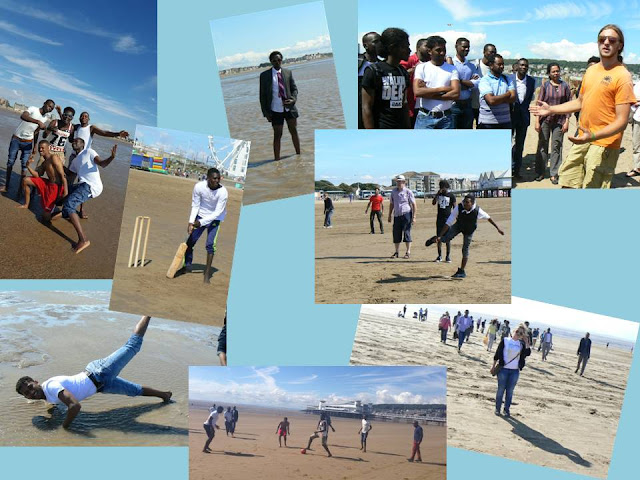
But we need other images too. We need images like those of the Olympic refugee team, parading with pride and competing with courage. Images such as those those I am lucky enough to have stored in my camera and engraved in my memory after a wonderful summer school week with my students from St Chad's Sanctuary at the end of July. These are crucial too. Crucial as a reminder that this struggling, desperate mass of humanity on the move is made up of people.
People whose lives have been interrupted by unimaginable suffering, for sure, but people with lives that are much more than just that experience. People who talk and cry and laugh, who sing and share and smile. People who struggle and question and doubt, but who also believe, hope and dream. People with energy and creativity and a sense of fun. People with gifts and talents and generosity. People who have lost much, people who still have so much to give.
People like us.
So here are my own #teamrefugees.
These are the smiling, inspirational people I want you to see every time the Daily Mail shows an image intended to invoke your fear and anger; or even when the Guardian wishes to invoke your pity.
Be afraid of the world we are creating, by all means; weep for the human lives it destroys, certainly... but then go out, overcome your fear and your pity, and make new friends.




So what we portray and how we do so is really important.
I was already thinking about this post before the Refugee team paraded into the Rio opening ceremony under the Olympic flag to thunderous applause but they are a symbol of what I was hoping to say. However well they do in the competition, I am very glad they are there.
I know it continues to be important that we see images of crowds of humanity huddled in shivering temperatures behind barbed wire fences and the bodies of children washed ashore on beaches from sinking boats which should never have been on the sea. I know we need to never tire of seeing the desperation and suffering of those fleeing horrors we cannot begin to imagine; to be reminded, again and again that no-one ever puts themselves, their loved ones, their families, their children in those situations unless they have no other choice.
But we need other images too. We need images like those of the Olympic refugee team, parading with pride and competing with courage. Images such as those those I am lucky enough to have stored in my camera and engraved in my memory after a wonderful summer school week with my students from St Chad's Sanctuary at the end of July. These are crucial too. Crucial as a reminder that this struggling, desperate mass of humanity on the move is made up of people.
People whose lives have been interrupted by unimaginable suffering, for sure, but people with lives that are much more than just that experience. People who talk and cry and laugh, who sing and share and smile. People who struggle and question and doubt, but who also believe, hope and dream. People with energy and creativity and a sense of fun. People with gifts and talents and generosity. People who have lost much, people who still have so much to give.
People like us.
So here are my own #teamrefugees.
These are the smiling, inspirational people I want you to see every time the Daily Mail shows an image intended to invoke your fear and anger; or even when the Guardian wishes to invoke your pity.
Be afraid of the world we are creating, by all means; weep for the human lives it destroys, certainly... but then go out, overcome your fear and your pity, and make new friends.


Friday, 5 August 2016


Saturday, 30 July 2016
This Year
For me it is this time of year, much more than December / January
which marks the end of the old year and start of the new. This is when I look
ahead to new adventures and start a new diary. This is
when it makes sense to stop and look back and celebrate the year that was. (But it's too long and probably not very interesting to anyone bar me, so don't feel obliged to read!)
In my world September is synonymous with
settling back into rhythms and routines. The return to school brought its usual
inherent busy-ness and both the joys and challenges of getting to know a new
set of students who have, I can safely say a year on, been amazing to teach.
Thrown in to the mix this year were the DSEi arms fair protests which, even as
they draw attention to the horrors of war and the arms trade; also provide space to stand together with those trying to do something about it.
Standing out in October was the half-term
holiday when we took a proper break and went away to Mytholmroyd. The weather
was kind: blue skies for beautiful walks in the daytime but cold enough to justify the open fire in the evenings. Cups of tea, good books and meetings
with friends: the perfect antidote to an otherwise busy schedule.
November marked the beginning of the next
phase of the life of our little community when, having visited for a few weeks
in September, Corline returned to live with us, making an open-ended commitment
to community life and venturing out on to this journey together.
As is invariably the case, highlights
abound in December, this year including the COP21 protests in Paris. If
outcomes from the summit were far from satisfactory; the energy and passion on
the streets were well worth being part of; not to mention the opportunity to
catch up with good friends (and good food and wine!) And then there were
parties: fun and friendship for Sinterklaas early in the month, and a beautiful
celebration of what Christmas is all about with those who gathered with us on Christmas day.
There can be few better ways to begin a
year than beneath the Valencian sunshine: warm weather and even warmer hospitality,
beautiful surroundings and beautiful prayer meant a once again wonderful Taize
meeting brought us into 2016, (although I may be getting too old for 36 hour
coach journeys) Sleep deprivation and beautiful experiences of prayer were
recurring themes in January: the end of the month was marked by the Birmingham
Churches Together 24 hours of prayer, a wonderful celebration of the unity of
the church in all its diversity.
I am sure something memorable must have
happened in February too, but nothing immediately springs to mind. Maybe I had
a nice, relaxed laid-back month doing not very much ...
An early Easter meant Student Cross fell
in March this year, and if Holy week coinciding with school term-time meant I
was only able to join in for part of the week, I was nonetheless pleased I
decided to join in for the bits I could. To walk, talk, reflect, share; to
renew old friendships and make new ones; to be community.
April’s Taize weekend provided a space to
sing and to be silent, to listen and to share. We are now looking ahead to a
much bigger gathering next April/May: which for all the work it may involve
over the next year I am very excited about (www.taize.fr/birmingham)! It was also in April, I think, that
I first got involved in the "Long Journey Home" project, working with
first generation migrants to provide a platform to craft and tell their
stories: it has been a privilege to be involved over recent months.
In May I handed in my notice at school. I
wouldn't say it was a highlight, but certainly a significant moment in this year's journey. It was a
tough decision and I knew I would be sad to leave a school I love, but it was,
is, the right one.
June was referendum month. Also definitely
not a highlight (although I did get to babysit my niece the same day and that
was quite fun.) We also headed to Reading ... not
because it is a particularly exciting holiday destination, but because, ahead
of the parliamentary vote on Trident renewal, it felt like a very important
place to be to say no to atomic weapons. An early start, a long and in parts stressful day... shared with some very inspiring people. I am glad I was there.
July has mostly been about celebrating!
Our end of year party brought together some of those who have shared in our
life in different ways in the last year. Then came the end of term and some
fond farewells to colleagues and students (and pink wafers and party rings!). And
just last week the St Chad's Sanctuary Summer School, including a fantastic day out in Weston Super Mare was a beautiful way to
round off the year there too.
There may well be some other significant bits I've forgotten about temporarily too - please don't be offended if it involved you! This blog post is quite long enough as it is.
In between all that we've welcomed a good few visitors and somehow
managed to squeeze in all our regular commitments: work, volunteering, welcome, silence, discussion, laughter, friendships and prayer.
The public prayers have now closed for the
summer, and if I do still have a lengthy jobs list for the next month, the
rhythm becomes somewhat more relaxed plus there are trips to both Taize and
Greenbelt to look forward to.
Tuesday, 26 July 2016
The first day
There are some wonderful authors with immense
talent and an amazing command of the English language: but if the magic of
stories is in the possibility to paint pictures which draw others in, and to elicit a rainbow of emotions from your listener, then it
turns out you can be a master story-teller long before you have the command of
grammatical tense.
I know I am hugely privileged to have heard the stories of so many remarkable people, and to have heard them told with honesty, emotion and good humour.
One of my students recently recounted his journey to and first day in the UK. He told of experiences no-one should ever live through. And yet, it was told, sprinkled with touches of humour and with a smile almost always on his lips: and as I listened, horrified, with tears in my eyes ... I laughed.
I think it was OK to laugh, because I
knew we were laughing together. Thank you M. I am honoured to call you my friend.
With hands which danced
Over these,
The studied words
Of a language not his own
These outstretched hands
And winning smile
Which spoke in truths
And offered up
A story and a life
And invited us
To laugh
And as he told
Of hands clasped tight
Around searing rods
Of fingers, bent and burned
From clinging on
From clinging on
To life itself
And as I listened
With hands clenched tight
Against
The shame of a nation
The shame of a nation
Daring to deny
His only hope
Somehow we laughed
And as he told
Of ears which closed
Against the haunting roar
Of deafening sounds
No-one
should ever have to hear
And as I recognised
How possible it was
For ears
to strain for the familiar
In a language that did not match
The school book scripts
Again we laughed
And as I half-heard
A tale of pain and fear and loss
Hidden
In simple-spoken truths
And the self-depreciating humour
Of survivalAnd as he shared
That defining moment
The unfettered, still-remembered joy
Of a dawning realisation
Yes,
I am free
I am free
Once more we laughed
And as he stops
And turns to thank
My countrymen and me
I wish he knew
How much he brings
These outstretched hands
And winning smile
Which offer up
This lesson to our humanity
This timely reminder
Of how to
Laugh.
Subscribe to:
Posts (Atom)