Saturday, 26 May 2012

Sun, sea and sand

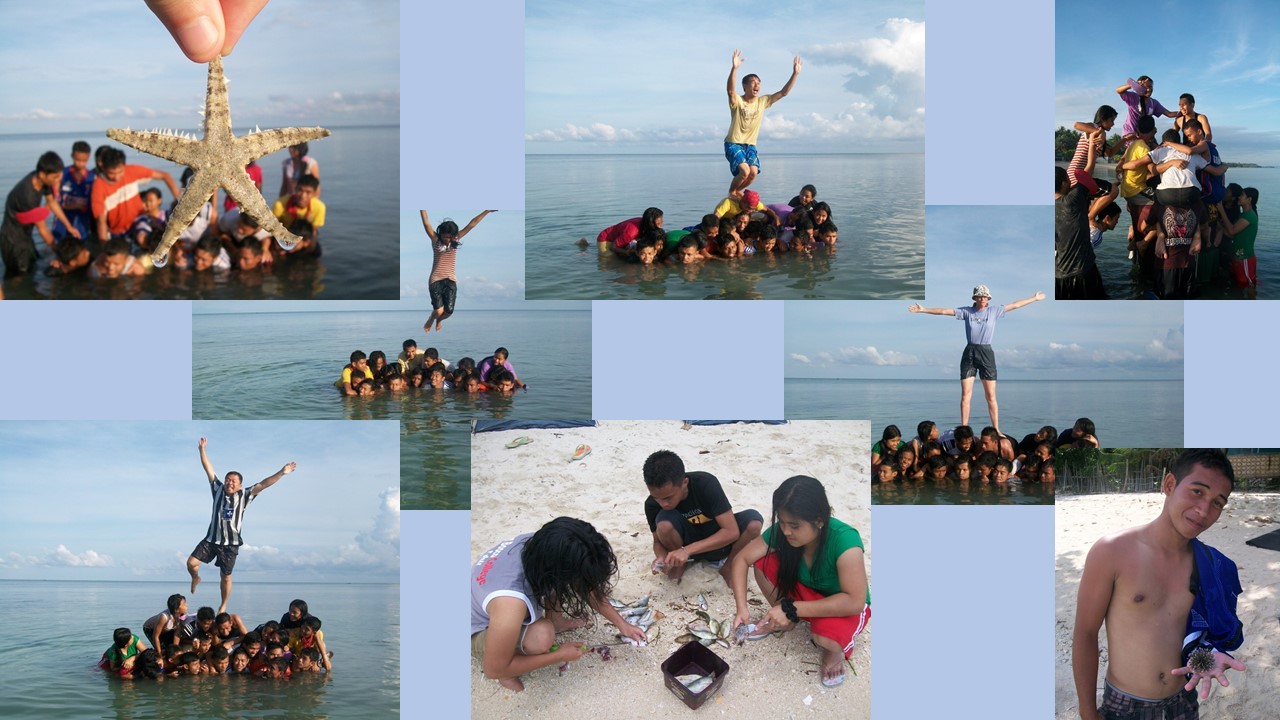
A 4.30am start last Monday morning did feel a little on the early side, but it did mean that even though it was a three hour bus journey to Tabuelan we had arrived at our destination, set up camp, had breakfast and were in the sea shortly after 9 in the morning.

Tabuelan, on the opposite side of Cebu island gets barely a mention in our guide book, but with white sand, palm trees and perfect blue sea, it proved to be an idyllic location for the leadership camp we attended with twenty of the TVED students earlier this week.

This was a residential for which I would not have wanted to complete the risk assessment, but such things are less of a consideration here. After all, it is all very well to be concerned with health and safety, but how are you going to have fresh coconut juice to drink if the students don’t climb up high into the palm trees to throw down the coconuts; and I’m all for food hygiene standards, but barbecued pork cooked on an open fire on the beach behind sand barricades built against the rising tide does taste very good!

Each morning we were up at five thirty (apparently turning the sound system on at that time is not considered anti-social behaviour) and in the water for a swim before breakfast to make the most of the relative cool of the early morning. In fact, in between the activities, which mostly involved the students crawling around blindfolded in the sand, much of the three days was spent in the water: and I spent much of it thinking how privileged I am to be here.


It was a fabulous three days, but we did also return with a renewed appreciation for a bed and the air con!

Sunday, 20 May 2012

Telling their stories


As part of the English programme, we asked all the junior students to write their own autobiography. It was a project which seemed to really capture their imagination and I was impressed (and I acknowledge mildly surprised) by the enthusiasm with which they set to work. With planning ahead a distinctly lacking skill here, I set the four week deadline with a degree of trepidation, expecting to spend the week after the deadline reminding them to get started; but no, the only ones not handed in on deadline day were those which the students had submitted early. I had offered that if they handed in a draft ahead of time, I would correct and help improve it, and many took me up on the offer (which rather added to my workload, but aside from that minor irritation I was very impressed!) The final copies, for the most part showed a huge amount of effort had gone in to both the writing and the presentation of their books, and I am delighted that they now all have a beautiful keepsake of their life so far.


Reading them I was touched by the openness and honesty with which they wrote. I had suggested that to make their autobiographies interesting, they should include thoughts, feelings and reflections: and they did. In most cases, what they wrote was an honest and frank account of their ups and downs, theirs successes and failures, their pleasure and pain, their loves and fears, their joys and their sorrows ... and they were happy to share all of that with me.

Much of what they wrote spoke clearly of the universality of the experience of childhood and adolescence: lessons they loved and hated, games, parties and excursions, the shifting parameters of relationships with parents, the importance of friendships and the highs and lows of dating featured prominently among their stories. Parts of what they wrote could have been written by any teenager in the world.

But amidst the mundane stories of day-to-day teenage life, there were plenty of parts that were hard to read, because they also wrote with searing honesty of the struggles and challenges of living with poverty: of not seeing parents who were forced to work away, of dropping out of school when there was no money for the transport to get there, of experiencing the bottom dropping out of their world when a parent lost a job and there was no safety net to catch them, of watching their parents in tears because of financial problems, of feeling hungry and not being able to eat.

They may just be like any other teenagers, but some of them have experienced things no one of any age should ever have to, and I feel extremely privileged to have had such a personal insight into their lives. Thank you to all the juniors.

Thursday, 17 May 2012

Reaping the rewards


With the last re-sits of the final exams last week bringing an end to the majority of our teaching, a major part of what we are doing here is now over, a fact of which we are very aware and so are the students. Although we still have six weeks left, it has been nice to feel appreciated, with lots of the students thanking us for teaching them and telling us they will miss us when we go back to our country.

With exams to invigilate and mark for almost 200 students, we had a very busy but on the whole quite positive few days at the end of April. The days of oral exams were particularly intense; a lesson in how much concentration is required to give 100% attention to each student, without thinking about the previous one or the next one or how many more there are to get through. Intense, but also intensely rewarding, especially with the senior students, who showed us that all the hard work had been worthwhile. One of our very first TVED experiences last October was observing the equivalent exam with the previous batch, and there is no doubt that our current students demonstrated more language but particularly more confidence in speaking English: our strongest students spoke fluently, but more rewarding was that even among the weakest students, nobody was tongue-tied and silent.

Once round one was completed, rounds two and three saw gradually dwindling numbers as many students passed and were signed off; but we were no less busy as we had intensive remedial classes with our struggling students (and our lazy ones) in the hope that most would make it through – and most did.

After a full timetable of “last chance” exams last Tuesday, Wednesday was D-Day for the remaining students, the day when we would sign their clearance forms, with good news or bad – and for most it was good news. After each round of exams we have been the bearers of some bad news, but lots of good news. Although it has been difficult to tell some students they haven’t passed, there have also been some real highlights in telling students they have passed: not so much the ones who we knew would pass all along, but those who have had to work very hard to make it through, and have received the well-earned rewards of their labour. The smiling faces with an occasional touch of disbelief, the handshakes, even a hug from one or two; the students who kept coming back to ask to see their score again, just to confirm it was still a pass a few hours later; the 100% pass rate in both subjects from WFT, our weakest class in each year group, through hard work and a lot of solidarity; those are the moments form last Wednesday I will remember and treasure. 

And those who are left, the last 18? Well with our naughtiest class dominating the fail lists, I think even the students, deep down, would admit that a lot of those who failed it may be because they haven’t worked quite as hard as they might have done! But we are not giving up yet and are still hard at it with special assignments (for which read intensive extra classes) and we’re hoping they will all be signed off, before we leave ...

Monday, 14 May 2012

Out of Eden - Part 1 - The Forbidden Fruit

This blog post is rather long, sorry about that, and theological, so anyone not interested in my theological ramblings is welcome to give this one a miss. If anyone does make it to the end - I'd welcome your comments!


The Genesis story of Adam and Eve is perhaps one of the best known Old Testament tales but for all its familiarity I wonder how often we pause to think beyond its superficial meanings and dig a little deeper into the soil of this garden. Here I share some of my attempts to do so, although I am certain there are many more layers I have not yet overturned.

In the beginning there is a garden. It is, or at least appears to be, a perfect haven of peace and security. Adam and Eve, humanity, are given the run of the garden; forbidden only from eating the fruit from one tree, the tree of the knowledge of good and evil. So if the garden represents the totality of creation, why this one forbidden fruit?

I imagine many explanations have been offered for the reason God forbade access to the tree of the knowledge of good and evil. The biblical text itself offers two, one given by God (“you are doomed to die”) and a second by the snake (“your eyes will be opened and you will be like gods”). Just as I am sure many have done before me, I am going to hazard my own explanation for this prohibition.

The suggestion is that the trees in the garden have been planted by God: the fruit of the tree of the knowledge of good and evil is the fruit of a tree planted and nurtured by God. Perhaps the reason God does not want humanity to eat fruit from this tree is because it is meaningless knowledge: however delicious and beautiful it may look, you cannot be fed and nourished by the fruit of the tree of someone else’s knowledge of good and evil. God forbids access to the tree of the knowledge of good and evil because he wants humanity to grow its own trees of the knowledge of good and evil. He does not want us to receive a set of truths, but to grow our own. The knowledge of good and evil, morality, is not an external set of rules, but something each of us must plant, grow and nurture for ourselves.

Maybe God, as parent, as teacher, knows that you cannot feed others from the fruit of your own tree of the knowledge of good and evil. Better, you must give them the tools and the seeds to grow their own tree of the knowledge of good and evil. And what are the tools we need to grow our trees of the knowledge of good and evil? Maybe there are indications in the genesis story that God also gives these tools to humanity.

Adam, humanity, is instructed to “cultivate and take care of” the garden. The Garden of Eden is not a readymade reality, but a place in which humanity is invited to be a co-creator. It is something which is incomplete and open to acts of creativity. Adam is also instructed to name the animals and “each one would bear the name the man gave it.” Names are significant. They are bearers of identity. This is not just about convenient scientific categorisation; the act of naming is a creative act. We are called to be creative.

Adam is given a companion because “it is not right that man should be alone”. From the beginning, the need for collective experience is recognised. Growing and creating are acts we do best with others. We are not meant to exist in isolation, nor will our trees grow best when they are grown out of selfishness or self-interest. We are called to be community.

With the exception of the tree of the knowledge of good and evil, humanity is “free to eat of all the trees in the garden.” These may be apples and bananas, but if the two named trees are knowledge of good and evil and the tree of life, we might imagine that the other trees also have symbolic fruits: and humanity is invited, even encouraged to explore and discover for themselves. We are called to be free.

Perhaps the prohibition to eat of the tree of the knowledge of good and evil is in itself also one of the tools we need. When we have planted our tree of the knowledge of good and evil and tasted its fruit, our pride in our creation, along with a genuine desire to share something which, to us, is truly beautiful, tempts us to feed our own fruit to others. What God knew, and we too often forget, is that our fruit, acquired through our experience, if we present it as what the fruit of such a tree should be, beautiful though it is to us, risks limiting another’s potential to grow their own tree, of which the fruit may be very different. We are called to be unique.

Growing our own trees of the knowledge of good and evil will take time, the fruit needs to ripen and mature, and, the chances are, even as it does so, it will be blemished and imperfect, but in spite of the imperfections it will be our fruit. It will be the fruit that will nourish us and the fruit that will be beautiful.

These are lessons that any of us who are educators could probably learn from. They are lessons that we, as individuals on a life-long journey of learning, need to recall.

Did God then, as the snake suggests, lie to Adam when he told him that in eating the fruit of the tree of the knowledge of good and evil he was “doomed to die”, or did he threaten a punishment which, in the event, he didn’t carry out, or is there another explanation for these words?

I believe in a God of Love, and love is not violent and does not threaten; plus I feel truth is probably inherent to the nature of God, so I felt the need to seek a different possible explanation, which is this: perhaps God was stating a reality. Although eating of the tree of the knowledge of good and evil did not bring about Adam and Eve’s physical death, perhaps it prevented them from experiencing life in all its fullness.

In eating of someone else’s tree of the knowledge of good and evil, we admit our willingness to accept pre-determined realities and perhaps our willingness to accept someone else’s truths prevents us from discovering the world anew with eyes truly open, allowing us to explore and to create new realities, a newness inherent in having life in all its fullness.

In eating of the tree of the knowledge of good and evil, we are tempted by acquiring something without the effort of producing it, eating of the fruit without being part of the creative and potentially often arduous task of growing it, an active participation inherent in having life in all its fullness.

In eating of the readymade tree of the knowledge of good and evil, we seek to possess what we do not have, rather than to create using what we do have. We stop using the seeds and tools we were given to grow our own trees. We deny our unique individuality and freedom to be someone different, but at the same time individualistic self-fulfilment becomes more important than creative community. And perhaps that is why every time we eat of someone else’s tree of the knowledge of good and evil, something inside us dies and we fail to live life in all its fullness.

Perhaps we need to start planting.

Thursday, 10 May 2012

Dreaming of distant shores


It is the end of the semester, the final exams are done and, with the junior students looking forward to their next semester, the seniors preparing for five months of on the job training, and a whole new batch of applicants being put through their paces with the three week orientation programme, it is a time of looking ahead.

For the students at TVED, the skills and qualifications they receive are a route out of poverty, and being able to earn a better living is undoubtedly a key motivation for all of them. Often their desire to earn more is not entirely self-centred: one recurring theme among the students here is their desire, by completing their studies, to assist or support their families.

For many, the idea of travelling abroad to work is an important part of this dream. For most, they don’t have a specific destination in mind: anywhere where their skills will earn them higher wages than they can hope for at home, and from where they can send money back to help their parents or younger siblings to have a better life. With thousands, maybe millions of Filipinos working abroad in every corner of the world (I know, the world is round so it doesn’t have corners, but you know what I mean) for some this may well become a reality.

While I in no way wish to criticize our students for their aspirations, nor cast judgement on their actions, there are two things which sadden me about this dream.

The first is that they feel this is the only option. The only way to leave poverty is to leave the Philippines. With stories of higher wages abroad and surrounded by the evidence (not least in the main fee-paying part of the school) of those who are reaping the financial rewards of working away it is easy to see why this is their dream. There is little debate about the truth of their belief that going abroad offers more opportunities for financial gain than staying here. But in a culture where family and connections are so important and the students talk about close relationships and their love of their families and communities, it seems sad that in order to help those very people they feel they have to go so far away from them. The evidence of the wealth generated by Filipinos working abroad is everywhere here, but there is also plenty of evidence of the damage to social fabric and family relationships. When the children from the main school are discussed, many of the discipline issues come down to students whose parents are abroad, sometimes for years at a time. Abroad, possibly, to give their children a better chance and better education: but is leaving them without parental care really giving them the best hope for the future? What a choice to have to make.

The second is that while the students talk about their desire to travel, the only motivation to do so they ever mention is the desire to earn a better living. I have heard no student speak of wanting to see different environments or experience a different culture, to see the sights or to meet different people. I have not heard them speak of lessons to be learned, nor (even less) of what they have to offer and give to other countries, other than their hours of labour. I feel hugely privileged to have travelled to many different places and met many different people, and I in no way want to suggest the TVED students I work with shouldn’t be able to do the same; nor am I suggesting that those who go abroad will not take part in important cultural exchanges, both giving and receiving, and making many new friends. But it is sad that this aspect of the benefit of travel isn’t even on their radar.

I sincerely hope that all the TVED students have the opportunity to live a better life as a result of their training and if for some that involves going abroad, I hope it is a fruitful and life-giving experience. But I mourn for a world where some can choose to travel to make new friends, and others feel forced to travel leaving friends and family behind; where for some, myself included, travel is an exciting opportunity to discover the world, while others live lives so damaged and limited by poverty they can see no other reason than financial gain.

Friday, 4 May 2012

Reflections on Catholicity


The Philippines (with the exception of a few Muslim areas in Mindanao) is an overwhelmingly Catholic country. The Catholic Church which arrived with the Spanish colonisers may have made its first inroads into this country by force, but now Filipinos seem to be willing and enthusiastic followers of the Catholic faith. In a country where one church is so visibly dominant, it seems appropriate to pause and reflect on what being Catholic really means.

Although our first association with the word catholic is often the Roman Catholic Church, in reality all the mainstream churches sign up to a creed which states belief in the catholic church: not as an institution but as a deeper reality of the nature of the church, the body of Christ. A church which is catholic, meaning universal, or even more accurately translated (so I am told) “pertaining to everything”. It is this idea of catholicity, universality, or “pertaining to everything” which I think merits further reflection.

Writing as I am half way round the world from my homeland, perhaps the most immediately visible significance of catholicity is that this is faith on a global scale. It is very easy to recognise, here in the Philippines, that the church here is the same church as the church in Europe, because it is, well, the same. But I am not sure this universal sameness is really what is meant by the catholicity of “pertaining to everything”. Perhaps the model of everyone doing the same everywhere comes from a fear that doing things differently creates tension and division, but inculturation is an essential part of the essence of the catholic church, not so as to separate the people of one place from a wider human family, but so that their faith can truly “pertain to everything”, something it strikes me is impossible for a church built on an imported model, which fails to pertain to the culture and reality of people in different situations.

Universality is about far more than just sense of place; it is also about an engagement within our own spheres, wherever in the world they may be. For a truly catholic faith that “pertains to everything” no issue, no question, no debate is “not a faith issue”. Our catholic, universal faith is called to engage with science, with politics, with economics, with social issues, with history and with the future. In order to “pertain to everything” the catholic church needs to be open and active and engaged, responding to different issues and to new realities. We should not be saying everything goes, but nor should we say that we the church already have the answers and know best. We need to be both speaker and listener, both teacher and learner, both expert and infant, both accuser and defender, both supporter and opposition: but never mere bystanders who look the other way.

So far, I have remained in the domain of thoughts and reason, but for me there is also a much more human face to this catholicity – it is a faith which pertains not just to everything, but equally, to everyone. By its very name and very nature the catholic church is called to inclusivity, is called to an openness to all: irrespective of their lifestyle, their culture, even their faith and belief, the definition of catholicity says everyone is in. For me this is the heart of the gospel message, and the heart of the meaning of “catholic”: Jesus, and in turn the church, turns to those on the outside, and draws an ever larger circle until everyone is on the inside. If the church defines itself by exclusivity, by who is in and who is on the outside, has it not lost the very essence of its own identity?

And finally what about on a personal level? What does it mean for me, as an individual to say whether or not my faith is “Catholic”? How should this universality, this “pertaining to everything” play out in my life? I guess it means having no closed doors and nothing that is out of reach. It means putting everything on the table and holding nothing back. It means not saying no, that part of me, that part of my life God can’t touch. It means not convincing ourselves that that part of me, that part of my life, to which I am so attached, God wouldn’t want to touch or change anyway. It means not predetermining what God wants to do with my life because it fits neatly with my own plans. It means praying, not to tell God what to do, but to listen to what he wants me to do.

Am I truly Catholic, well, if I am honest, probably not yet ... but I am working on it...

Monday, 30 April 2012

I am and you are

Those of you with particularly good memories might remember that way back in November I wrote a poem inspired by the "I am statements" in John's gospel. (http://www.stepsadventures.blogspot.com/2011/11/artistic-interlude.html) This second poem and painting, inspired by the same verses along with one of my personal favourites "I have come that you may have life in all its fullness" (John 10:10) is maybe a little more abstract, but if you search for them, I hope you might be able to identify references to all seven "I am" images: the good shepherd, the gate, the bread of life, the way the truth and the life, the resurrection and the life, the vine, and the light of the world.


I am
And you are

Walk my way
Living is being

Called by name
Called to be you

Called in to shelter
Called out to shine
With the light of love

Called to have life
In all its fullness

I in you
You in me
A vine, intertwined

Together
Living
And being

Loving because I am
Loved because you are

Giving myself
Still, I am
Give of yourself
Even more
You will be

I am
And you are
Come,
Go,
Love,
And live!


(John 6:35; 8:12; 10:7; 10:14; 11:25; 14:6; 15:1)

Thursday, 26 April 2012

A window on our world


In sharp contrast to our two years in France, where we welcomed many visitors and visited many friends, our social contact this year has lacked the variety we have perhaps come to take for granted; and our opportunities to host visitors have been distinctly limited: which is not to say it has not been a sociable year; it has. Part of our motivation in coming here was an exploration of life in community, and I enjoy sitting down each day to community meals and having a routine of regular community prayers. Our work at TVED is in no small part a social role. As much as ever, we spend a lot of time with other people, the difference from past years being that they are always the same people. It is an interesting reflection that this in some ways intense community experience involves spending nine months with a group of people who, when we say goodbye in a couple of months, there is a strong chance we will not see again.

One of the things we loved about living on the edge of Paris was how many people came and spent time with us: it made me feel very popular, even if the Eiffel Tower was the real attraction, rather than me! We knew this year we were unlikely to receive anywhere near as many visitors (if any at all), and were delighted when one friend decided to make the trip. It was a particular pleasure to welcome Janet when she headed half way round the world to join us during her Easter holidays: I only hope she enjoyed her visit as much as I did. Aside from lots of long conversations putting the world to rights, some extra help in a few lessons, and an excuse to be tourists for a few days; welcoming another European visitor was also a reminder to look again at the world which surrounds us here. A reminder that many of the little things which have just become part of our daily reality are actually very alien and different. An opportunity to reflect again on our experience and open our eyes anew to our environment. Which is as good an excuse as any to publish some photos of our local area, hopefully opening a window, albeit a small one, into our world:


Janet is in the process of publishing her reflections on her trip which can be read here: http://jeepneyskaraokemutantcoconut.blogspot.co.uk if you are interested in a different perspective on Cebu.

Tuesday, 24 April 2012

Island Hopping

The Philippines is made up of more than 7000 islands, and we have no intention of ticking them all off during our time here, but a couple of recent trips have taken our total to 7.

After a late night on Easter eve for the post-vigil karaoke session, we were up early the next morning for a return trip to Bohol, the island we visited after Christmas. We would be back in the classroom on the Tuesday so spent just one night in the jungle hideaway of Nuts Huts. Although it wouldn’t always be convenient, I do approve of places you can only reach on foot: it gives a certain satisfaction to arriving! Not that we were energetic all the time: there was a lot of sitting admiring the view; but we did also kayak up stream to the nearby waterfalls, where, somewhat to my own surprise, I managed to get back into the kayak without capsizing it after a swim in the refreshingly cool plunge pool.


A week later we were back at the port, this time heading to the fabled city of Dumaguete on Negros. Fabled, because, home to one of the other Salesian communities in the Philippines South province, Dumaguete is spoken of with great love by the community here, all of whom would quite like to be assigned there ... and after a couple of days, it was easy to see why it might be a more popular place to stay than Cebu. A much smaller city than Cebu, Dumaguete is quieter, calmer and altogether more attractive. Appeal undoubtedly added to by its sea front promenade and beach, sea you could happily swim in, and spectacular countryside in easy striking distance, including the 30m Casaroro falls. Less accessible since typhoon Sendong destroyed the access path and bridge, it was well worth the scramble over the rocks and through the river to find them.


During our stay on Negros we also added another island to our list, with a day trip to the tiny but idyllic Apo Island. Apart from a brief trip up to the centre of the island we spent the day on the beach and in the perfect blue sea. Neither words, nor photos can really do it justice; and not owning a waterproof camera, you will just have to take my word for the beauty of the underwater world of the coral reef, with its colourful fish and most amazing of all the turtles with whom we swam through the coral.

And if you were wondering, yes, this blog post was really just an excuse to share some holiday photos. 

Saturday, 21 April 2012

Alleluia! Christ is Risen!

After a fortnight without updating my blog, the longest gap since arriving in the Philippines 200 days ago, I have plenty to catch up on, beginning with a greeting:

Happy Easter!

For anyone who is thinking it is already a little late for such a greeting, I disagree. With the Easter season lasting 50 days, I am well within my rights to still be celebrating the resurrection.

It strikes me as significant that in the church calendar, the season of Easter lasts for longer than the forty day period of Lenten fasting which precedes it. This is, to my mind, no mistake and no coincidence: the period of celebration should surpass, not only in time but also in magnitude, the suffering before it. It is sad that all too often, Easter is reduced to one day of gorging on chocolate to mark the end of a time of fasting, rather than being lived as an extended time of joyful celebration. With or without karaoke, Easter should be a party which exhilarates and inspires, and one which lasts.

This is my faith. A faith where joy and celebration outweigh sacrifice and suffering. A faith where self-giving gives birth to the greater joy of loving and living together; and where limitations only serve to engender the deeper freedom of fulfilling true desires.

This is my faith. A faith where eternal life is not a reward for a life of duty to be laboured for and looked forward to, but is a reality to be lived here and now in the fulfilment on each new day.

This is my faith. A faith which encompasses Lent, certainly, but where Lent is immeasurably surpassed by Easter joy.

This is my faith. A faith of resurrection and of life.

Happy Easter!

Saturday, 7 April 2012

A day of emptiness

Today is Holy Saturday and God is dead.

It is a time of sadness, grieving and desolation.

This week is the biggest week of the church year, and lived and experienced as it should be, it is a roller coaster of an emotional journey. Sandwiched between the suffering of Good Friday and the joy of Easter, the risk is that Holy Saturday becomes little more than a rest day in the midst of a busy liturgical time, or a day of preparation and getting ready for Easter.

But maybe Holy Saturday is an important moment in its own right. This space between crucifixion and resurrection matters.

Most of our liturgy, most of our faith is a celebration of God's presence. Immanuel, God is with us. The incarnation is about God becoming one of us, becoming closer to humanity by becoming part of humanity. And it is right that God's presence with us is the primary focus of our church, our liturgy, our faith.

But what about today?

It is also the incarnation, the same incarnation of God with us, that, at this point, brings us to an intense experience of the absence of God, of a sense of desolation and separation. Today is the only day of the church year when we commemorate not God's presence, but his absence. Written into the calendar of a faith built on God's presence is a day when God is absent. It is a day of emptiness and absence: which presents a challenge we are perhaps tempted to shy away from.

Of course, we know this is not the end of the story. Inherent in the emptiness of Holy Saturday is the anticipation of what is to come. The end of the story never changes. Because of this anticipation, the absence and desolation we feel cannot equal that of the first disciples who really did experience, in the depth of their beings, turning upside down their entire existence, the Death of God; who lived this time as a moment of total absence of consolation and hope.

There is nothing wrong with anticipation. But maybe today is about more than just looking forward to the resurrection, or even back to the crucifixion. Maybe it is too easy to empty today of its meaning, by looking somewhere else or; by pre-anticipating the end of the story and denying this as a time when God is dead.

But maybe today is about stopping and looking in. Maybe today, in the midst of the preparation and anticipation for the resurrection, we need to find time to experience and in some way we don't fully understand, to appreciate the absence of God.

After all, it is this absence and desolation which makes an explosion of joy possible at Easter. It is this emptiness which creates the space for new life to be possible.

Friday, 6 April 2012

Today you will be with me in paradise

As promised, another poem for Good Friday. The footprint on the accompanying picture, incidentally, has nothing to do with yesterday's post. Rather it is part of a (currently incomplete) way of the cross. 

Contrary to what is sometimes suggested, the men crucified either side of Jesus are unlikely to have been common criminals or petty thieves. Crucifixion was a punishment reserved for those the Roman Empire saw as a threat to itself, and let us make no mistake, Pilate may have washed his hands, but Jesus’ message of equality for the poor and freedom from oppression was definitely a threat, even if it was preached in love and peace and without violence. It was a threat to the empire, in the same way that Ghandi’s peaceful march to the shore to make salt was a threat to the British Empire in India, and the same way Martin Luther King’s demand for equality was a threat to the establishment in the USA, but I digress.

The point is this, those who are with Jesus in his final moments of human life, those who take up their cross and carry it with him, those who do not abandon him even when all his closest friends have fled, are not just any old criminals. In all likelihood, they were Zealots, the Jews who had taken up arms to try to expel the Roman occupiers. They are those who, at least in part, share his convictions. They share his convictions of freedom from oppression, even if they have chosen the wrong route, to try to share their message, resorting to the violent tools used by the oppressors themselves.

Small wonder, perhaps, that it is to one hanging on a cross beside him that Jesus promises, “You will be with me in paradise”. The ‘repentant criminal’ may not have fully understood the gospel, in the face of hatred and hardship he may have resorted to those same tools of violence, he may not have lived a full and true life of love; but he knew that standing against oppression was worth dying for, and he did.

“Today you will be with me in Paradise”

Abandoned by those he shared his life with
Abandoned as they run away in fear
Abandoned but not yet alone
Those you might not expect remain near

He offered love and consolation
But there is a challenge in being his friend
Take up your cross and follow
Walk this road with me to the end

But somehow when it came to the moment
It was others who were at his side
A man of love between men of violence
As he suffered, as he died

Those other nail-scarred hands
Whose wounds cut just as deep
Whose pain is just as real
Whose friends look on, whose families weep

A fighter against injustice
The courage of a cause that is right
Standing firm in the face of aggression
How sad he chose weapons to fight

To fight against oppression
He chose the oppressor’s way
He raised his hand in violence
He let night be stronger than day

Can love be preached with a sword?
Freedom brought through the barrel of a gun?
Injustice can’t be beaten by violence
But with love the battle can be won

But he saw in that other a hero
A shared conviction, and message to tell
A different route of humble innocence
Let me walk that way as well

The same message against oppression
A shared truth they both believed
Give life to the poor and the outcast
Thus a gospel of truth is weaved

Did he realise in that moment
As violence scarred his flesh
That another way was better
Was it too late to start afresh?

A violent death expected
Maybe a violent death justified
He too chose weapons of destruction
So from violence had no place to hide

But he embraced the other’s innocence
With arms stretched wide on that tree
When you come into your kingdom
Please, Jesus, Remember me

You too have seen the injustice
You too have paid the price
The answer, ever loving
Today, join me in paradise

Thursday, 5 April 2012

On Holy Ground

This week has been marked by the sad demise of my sandals, and after seven and a half years it is time to take them off for the last time. As I do so, inspired by something I was asked to write a few months ago, the verse “Take off your shoes for this is holy ground”, God’s call to Moses from the burning bush, comes to mind. Appropriate, perhaps, that I should be writing this post today when God again calls his disciples to remove their shoes. There is a symbolism of service as Jesus washes his disciples feet, but maybe also a reminder that this ground, this place of encounter, this shared meal, this experience of the every day, is our Holy Ground. A recognition of this place as Holy Ground is the context in which self-giving service becomes a reality.

The death of my sandals, originally bought for our trip to Peru in 2004 is a chance to reflect on some of the Holy Ground they, and I have walked on these past few years. All told, my sandals and I have covered a good few miles (and that’s without counting the miles it has been far too cold to cover in sandals!).

Iquitos in the Amazon jungle was my first experience of visiting a very different and considerably poorer part of the world and my time there undoubtedly contributed significantly to where I am today. Since leaving the Amazon jungle, my Holy Ground has spread out to cover quite a few places in the UK and Europe, as well as a few further afield.

I have walked on Holy Ground in many parts of the UK and Europe surrounded by natural beauty (and sometimes manmade ugliness). I have walked on Holy Ground in Cuba, where despite the imperfections and abuses, there is evidence of a semi-successful attempt to work with a model different to the dominant god of Capitalism. I have walked on Holy Ground in the Philippines, first in the North meeting producers of recycled, far-trade products and being inspired by the reality of making a difference (www.fairgrounds.org.uk) and now here in Cebu. I have walked in Taizé, where the Holiness is tangible, holy ground I walk away from each time refreshed and renewed.


My journey across my Holy Ground is a journey which has taken me to a lot of different places in a lot of different ways. It is a journey that has taken me far from home as well as to more familiar surroundings. It is a journey over ground which is easy to recognise as holy, and ground where you have to search for holiness. It is a journey of walking to meet many, many friends old and new. It is a journey which has opened my eyes to different realities and moved me to new places. It is a journey of growth and change (although not of shoe size, fortunately!) My holy ground is truly a complex patchwork of places, people and experiences.

It is a journey I feel hugely privileged to be walking. All of this is my Holy Ground, and with a new pair of sandals, it is time to keep on walking.

Friday, 30 March 2012

7 last words

My plan was to put this poem up next Friday but I have now almost finished writing another poem, also on a Good Friday related theme, and thought two in one day would be excessive, so have brought this one forward a week: which seemed more appropriate than delaying it and putting it up during the Easter season.

The Philippines is famous for its Holy Week commemorations, particularly people nailing themselves to crosses although that only happens in one place, and nowhere near Cebu, so that's one cultural experience we won't be taking part in. It remains to be seen how Holy Week will be celebrated here, although so far Lent has been remarkable only by how unremarkable it has been. Other than purple stoles and no meat on Fridays, (and as we often eat fish anyway that's hardly worthy of much note), there has been little to mark out lent from the rest of the year .. but we shall see what this week brings.

Anyway, a few fruits of my own Lenten reflections:

Father forgive them, they do not know what they are doing

Do they know?
This pain inflicted
Not with nails
But with oppressive domination
Do they know?
Their violence
Cannot silence the voice of love

In truth I tell you, today you will be with me in paradise

Where am I going?
to death
Or new life
Where is this paradise?
Is it as you expect?
It is here on this cross
Journey with me

Woman this is your son. This is your mother.

Open your doors
Open your hearts
One to another
Be a family
Be my family
Be one
Share my love

My God, my God, why have you forsaken me

Alone and abandoned
Only I can live this moment
Only I can die this moment
Not forsaken
But dying to this world
Dying as humanity
Dying as God

I am thirsty

I thirst
In the depths of my humanity
I thirst
Not for the bitter wine of my pain
I thirst
For the living water
Of love outpoured

It is fulfilled

Is this what the promises promised?
Is this what the prophets saw?
Is this what you sought when you followed?
It is the only way
Fulfilment found
In love
To the point of death

Father, into your hands I commend my spirit

I give my spirit
I give my all
Offered to the world
Offered to the hands of God
Offered in love
Take what I offer
I say no more

And you
What will you say?

Tuesday, 27 March 2012

I lift up my eyes to the hills

One of the many activities which make up the TVED programme is the "Youth Encounter" a three day retreat (encountering themselves, each other and God) which takes place in the "Don Bosco House of Peace" in Mantalongon. Each of the last three Fridays a group of students has set off, and each of the last three Saturdays, after our lessons finish, we have set off to join them, staying the night and returning with the students on Sunday afternoon. It has been a welcome break from the somewhat mundane routine of planning, teaching and marking, and also been very positive to spend some time with the students outside the classroom.

Mantalongon is about a three hour drive from Cebu, including the last half hour or so up a steep and only partially paved mountain road. For some of the students, who have never left Cebu city, it is a major adventure. For us, currently living on the opposite side of the world and accustomed to travelling fairly extensively around Britain and the rest of Europe, talking to some of the students gave a real insight into how small their world is. We talk about the world shrinking because of technology and transport, but for some of our students the world is very small in a completely different way, and the world outside that still seems like a very, very big place.


Being in the mountains, Mantalongon is noticeably cooler than Cebu, which for us has been a welcome respite for the ever-increasing summer temperatures; and for the students has brought another novelty: feeling cold. By British standards, it would hardly be described as cold, but then we do have glass in our windows, central heating and appropriate jumpers, coats and shoes.

The middle weekend was notably marked by my overnight battle with a very hungry mosquito, which I lost, spectacularly, meaning I spent the following two days looking like I'd been in a fight with my face so swollen that keeping my eyes open required physical effort. The swelling had gone down by Tuesday allowing me to count the 32 bites! For this weekend's trip, duly armed with an extra weapon in the form of insect repellant, it was my turn to come out on top!

Each Sunday morning we have been awake at 4.30am to be out and hiking up the nearby Mercado Peak by 5am. It has been a very pleasant change to be somewhere cool enough to go for a walk of a reasonable length at a reasonable pace. The top of the mountain is the location for photo taking, breakfast and individual silent prayer. Each week, the weather for these morning excursions has been gradually improving. The first week we sat on the mountain top buffeted by wind and rain, with some students believing they might die of cold.  The rain held off for our second climb, but any sort of view was shrouded in cloud. Third time lucky, for our final trip, the weather was perfect: still cool enough to be pleasant but bright with just a light breeze, meaning when we reached the top of our climb a spectacular view of the surrounding mountains and the sea were spread out beneath us.

With the sessions mostly conducted in Cebuano, I can't really comment on the content of the retreat, but I know enough to know that the whole experience is something the students won't forget, and, in spite of the very uncomfortable bus rides, and not having had a lie in or day off for a month, it's something I am very glad we were a part of.

Wednesday, 21 March 2012

In their own words, part 2

You may remember that a while back I posted numerous quotes from the brochures for TVED which the senior students wrote for their English group assignment. Along with the written task, part two of that project was to produce and perform a television advert promoting TVED.

The quality, as you might imagine, varied considerably, as did the amount of effort the students put in to their production (not everybody made their own set of chalices from cardboard and silver foil, or paper ties colour-coded for the different courses, or borrowed uniforms from the students on other courses). It has taken me a while to get round to it, video editing is a time consuming process, but here are the edited highlights of what were probably the best three.

Thursday, 15 March 2012

What we take for granted, part 4

It is now summer in Cebu. I'm not sure why the Philippines has its summer in March and April, but it does. TVED are still hard at work, but the main school broke up last Friday for the long summer break and the college will be ending their term soon too.

But although it is now summer, there aren't many indicators of the passing of the year and the changing of the seasons. It may be the hottest time of the year, but it hasn't exactly been cool the rest of the time, and the temperature increase is fairly negligible. The length of the days has changed slightly, but the shift from darkness falling at about 5.30, to about 6pm is insignificant enough to be barely noticeable.

In some ways, I have really enjoyed missing a winter. I have enjoyed not having to wrap up in endless layers to step outside. I have enjoyed swimming in the sea when I know friends back home are curled up by the radiator.

That said, there is a rhythm created by the passing of the seasons that just isn't as marked here. The year is passing by, but there is little to differentiate this month from the last. We might not like winter much, but maybe we do take for granted the variety of the seasons and the way it structures our experience of the passing of time. We might not like winter much, but it does allow us to appreciate spring.


Don't get me wrong, on those days next winter (of which I'm sure there will be many) when it scarcely seems to get light all day, where the wind whips your face and when although it is not exactly raining you end up soaked to the bone only minutes after stepping outside, I will be dreaming of a Filipino December.

But the crunching of autumn leaves beneath the feet, a bright, crisp day with a sparkling frost (and then coming in and snuggling up with a duvet), buds of leaves and blossom and the first daffodils, long summers evenings where the sun shines until way past bedtime. Maybe these are things I will appreciate just a little bit more next year.

Thursday, 8 March 2012

Literacy and literature

I am a great lover of literacy and literacy teaching, so designing a literacy curriculum from scratch ought to be my dream job: and I am enjoying putting together an appropriate and adapted programme for our students. I am, because I am a bit of a grammar geek, enjoying organising the progression of skills and finding ways to explain at least some of the complexities and subtleties of the English language. But there is one thing that has made planning the curriculum here less fun than it might have been ... there are no books.

I have never taught literacy without books before, and, if I am honest, I wouldn't want to again. Being here has only served to reinforce in my mind (as if that were needed) that literacy and literature are and should be inseparably intertwined. I am sad enough to think that grammar can be fun and that playing with words is endlessly stimulating, but it is more fun in real books than in an abstract form. 

Part of the reason for the lack of books is financial, and my best laid plans of photocopying texts were also stymied by financial restrictions on paper, but the subject matter and expected outcomes also squeeze out the potential for literature in our literacy. The English curriculum here is teaching "functional literacy skills" - the English the students will need to survive in the workplace - so they can write an application letter, but we never write a story, they can read a set of instructions but not play with words in poetry. It is a sad reality that function has squeezed out fiction.

Don't get me wrong, I agree language should be functional. Its primary purpose is to enable communication and it is a great joy to me that, as an English speaker, language opens up a whole world of potential friendships, but I can't help feeling that language is also so much more. Yes, some would argue, linguistics is a science, but language itself is definitely an art: and like all the best art it should communicate something certainly, but also provoke questions and move you to new places, it should inspire thought and invoke emotions. It should be beautiful, which even the most well written CV, well, isn't.

There are interesting further reflections beyond our own educational circle. In the bookshops in Cebu the vast majority of the books are written in English, and the remaining small section is of Tagalog books: neither of which are the first language of our students and the population of Cebu. Cebuano exists primarily as an oral language, meaning you have to be relatively fluent in a second or third language before really being able to read at all. It makes for a culture much less literacy based and much less literature based than our own. Being able to read and having access to more books than I could get through in a lifetime, in my first language is yet another thing I take for granted.

So although I hope our students will speak and write English more fluently by the time we move on from here, and although I hope they will be in some way inspired to continue learning and exploring the language, I can't help feeling a little sad that in its functionality maybe we aren't doing justice to the beauty of language. 

So I encourage you to go, read a good book, a book that inspires, a book that is beautiful.

Saturday, 3 March 2012

What we take for granted, part 3

We seem to be, at least briefly, in a period of relative routine at the moment, meaning our lives are dominated by planning, teaching and marking, which is, primarily, what we are here to do. Hopefully, by the time we leave, the students we teach will be marginally better at maths, and marginally more confident English speakers, and perhaps more importantly we will have written a teaching programme adapted to their situation and needs which will be able to be taught here after we leave.

Maybe because it is something of which we all have first hand experience, maybe because deep down we all recognise its central importance, education is something which generally incites interest and comment from, well, just about everybody. It is something that I, as a teacher, am of course very interested in, so prolonged contact with the education system here has given me plenty of food for thought.

On a global scale, the Philippines track record on education is fairly reasonable. Free, public school education is widely available and over 90% of children finish primary school, many of whom also complete high school. A system of state "night high schools" running in the evenings for students who have to work during the day, extends opportunities to those who might otherwise be outside the system. A closer look at the figures does show that the near 100% completion rate in Manila distorts the figures which range downwards to only about 30% in parts of rural Mindanao, but even so, the figures here are not as bleak as in numerous other countries.

All of the students we teach have made it through the basic education system, and emerged as high school graduates. For some, this in itself is a considerable achievement. TVED is the next stage, an opportunity for further education, which is the educational domain dominated here by private institutions and therefore for many students, including ours, prohibitively expensive.

As can be expected in any education setting, the ability of our students varies widely. Natural intelligence, of course, has a role to play. That said, as students who have "graduated" from high school the number who lack even the very basic skills is astonishing. How have so many of our students reached their late teens or early twenties unable to do simple calculations? Why did I spend a session teaching a 24 year old to count backwards on his fingers, something he appeared never to have seen before?

I haven't actually visited any public schools. I am sure some of them are doing an incredibly good job with very limited resources. I am sure there are some outstanding teachers striving to their very best for students in circumstances I have never had to contemplate. Obviously I don't know the many issues and questions which contribute to the difficulties of the Philippine Education System, nor is it, really, my place to judge. That said, I suspect an inability to fund the education system as fully as is needed, leading to huge class sizes and limited resources is probably a factor. I also doubt that the education system is exempt from the endemic corruption for which the Philippines is renowned. I have no easy-fix solution to offer, but it is certainly true that, whatever the causes and whatever the solutions, a lot of young people are being failed by this system.

Meanwhile, I certainly have no illusions about the British education. I do not think it is perfect. I wear no rose-tinted glasses. In fact, like most teachers, I can quickly identify many of its flaws and have experienced first hand its many frustrations. Our system's insistence on a results driven syllabus which can be measured by how many students can tick a certain box, and the valuing of individual academic achievements at the expense of everything else are, in my eyes at least, barriers to achieving perfection: the perfection of a system which inspires every student with a love of learning and a sense of their own inherent worth.

And yes, I know there are children who have been, and who continue to be failed by British education, which, in one of the most "developed" nations in the world, remains a scandal.

But somehow, I'm not sure we always appreciate enough just how good we have got it. So, even with a Conservative government claiming that I "am happy with failure" because I think academies are a really bad idea, even with Michael Gove at the helm of Education; we do still have an education system of which we should be proud. Not proud so we don't strive for something better, but proud so we don't forget to appreciate what we already have.