Friday, 28 March 2014

Walking the Way of the Cross

I guess it could be said that this blog post has been more than two years in the making. Certainly, the paintings of the Stations of the Cross date back to our time in Cebu. By the time they were finished it was well after Easter and didn't feel appropriate to publish them. The crosses too, come from the Philippines, being made from dried palms leaves from the courtyard outside our bedroom. Some of the words were also scribbled down at that point, somewhat incoherently; and I have returned to them periodically and scribbled some more, before finally turning them into the form in which they appear here as the basis for our Lenten Friday evening prayers this year.

The idea of walking or pilgrimage, and the image of holy ground are powerful ones for me, to which I have found myself returning at intervals. I offer them to others in the hope that they might mean something to you too.  


Monday, 24 March 2014

Inside the institution

I would suggest that one of our deepest human desires, or perhaps even needs, is to belong. We yearn to be part of something bigger than our own individual identity. Something deep inside calls us out towards one another. It is a response to this desire we are trying to live out in our current project of creating community here.

Of course, while our desire to belong can be beautiful and creative it can also be horribly destructive when we unite around what we are not, around being in because we're not one of the other who is out. Uniting around the common enemy is an ever-present danger which I am sure I could write about at length.

But today I want to reflect on other complexities and on one of the dilemmas that I think the need to belong throws up for me. I wonder whether it has resonance in the lives of others too.

I want to belong. I believe deeply that we are made for community and for relationship with one another. That is why we create groups, and organisations and institutions: I believe all of these are created out of a human need to create orders and systems through which we can be together. On the other hand, I defy any institution to correspond entirely with my thoughts, feelings, beliefs and behaviours.

What then do we do when we desperately desire to belong and to conform, but when the institutions to which we wish to belong seem to contradict our most deeply held values? How do we balance being true to the unity of our communities and maintaining the integrity of our decisions and expressed opinions? When is it right to remain silent for the sake of those we care about and when is it our duty to use our love as a platform for challenge? These are not questions to which I have easy answers. They remain live questions for me, and I share them as such.

The church, in its broadest sense, is a classic example: I believe deeply that as Christians we are called into relationship with one another: it is impossible to be a follower of Christ in isolation. I cannot be the Christian I want to be without the church; and yet how often do I despair at things said or done in the name of my faith which I disagree with to the depths of my very being?

As you may have guessed there are particular recent examples (well, they were recent when I started writing this anyway ...) which have inspired these reflections. Some are on a large scale, some much more intimate.... but my relationships with the institutions and communities concerned makes me question whether I should name them here, in what is, at least in theory, a very public forum. Yet if I don't, does this just sound like theoretical nonsense with no basis in a practical reality? On balance though, I think I'll risk sounding like I'm talking nonsense.

Sunday, 2 March 2014

For the love of Taize

In a couple of weeks we welcome one of the brothers of the Taizé community to join us in an evening of prayer at the church here. In an attempt to explain to others here just why this small corner of Burgundy is so important to me, I wrote the following for the church magazine. I share it here too, just in case anyone reading this hasn't heard me wax lyrical about this subject often enough ...

Many of you already know that the Taizé community is dear to my heart and a place that has played a hugely significant role in my journey so far. I don’t know where I would be without it, but it’s fair to say, probably not here. 

I want to begin by clarifying that although Taizé is often primarily associated with a particular style of music, it is about a whole lot more than that. Taizé had been getting things right for quite a while before they invented the Taizé chant. It is not, either, just about a particular way of praying. Although I do think it boils down to the centrality of that prayer. There are no compromises on the importance of prayer. Even on busy summer Sundays when up to 4000 people might be leaving and the same number arriving, the information point closes during prayer. Even the vending machines switch off during prayers.

And while it is not just about a style of prayer; it is about an understanding of prayer that much of the church would do well to heed. Prayer is not about lots of words telling God what we think he should be doing. It’s about stopping, listening and allowing Him to take us places we’re not sure we want to go. It is about allowing the whisper of unconditional love to shout louder than all the surrounding noise. Taizé’s rediscovery of the importance of silence, and their ability to make it accessible to all is an important gift to the wider church, should they choose to accept it.

I don’t just go to Taizé for the prayer. I go too for the sense of community, the shared meals with people from all over the world, the perceptive insights in bible introductions, the belief in the possibility of a meaningful ecumenism, the possibility of deep sharing with people you have only just met, the sharing in the work that makes the community run smoothly, the simplicity of life where it doesn’t matter that  I can’t check my emails.

But it still all comes back to prayer. Everything else works because it flows out of that absolute commitment to being open to listening to God. It enables the trust which hands over much of the running of the place to those who arrived a couple of days earlier under the supervision of young people who arrived only a couple of weeks before. It enables the trust which encourages each individual to take the implications of the gospel seriously without trying to make it more palatable to our western sensitivities. It enables the trust that hands over a gospel that says you are loved regardless, knowing that implicit is the challenge to go and live a life radically altered by that experience.

Taize is a place where I have been allowed to experience the consolation of the gospel so palpably that I have perhaps dared to face the challenge of the gospel just a little bit more than I might have done otherwise. And I am very grateful.

Saturday, 22 February 2014

A rollercoaster ride

Like all  good new year's resolutions, my intention to keep my blog more up to date this year lasted until precisely half way through January. It is certainly not for want of things to write about it. Life feels rich and full and exciting at the moment. Whether any of it is interesting to read about or not is probably for others to judge. Perhaps it is no bad thing that I don't put pen to paper, or type to screen, too often.

Perhaps it is no bad thing either that I am too busy living life to have time to write about it: although I am not so sure about that one. Being caught up in the act of living is of course important, but I hope that living life to the full and reflecting on life don't have to be mutually exclusive. Perhaps that is one reason why the ten minute silence built in to our prayers twice a day is so important, it is a safety valve in an increasingly hectic schedule.

I am aware, of course, that living life to the full doesn't just mean being incredibly busy all the time. I am sure the two aren't always compatible and that being incredibly busy can often be a barrier to fullness of life. I am a great believer in taking time to be, not to do. To experience not to rush past. And yet at the moment, I feel life is both full in the very-busy-all-the-time-sense, and in the full-as-in-fulfilled sense of John 10:10: "I have come that you may have life in all it's fullness"

It was reflecting on a particular 24 hours of what has been a regular roller-coaster of emotional tensions that inspired this blogpost, and confirmed my reflection that yes, life at the moment is full, not because of the busy-ness of a whole host of things to do and not enough time to do them in, but because of the capacity to really feel and really live each one of them, even when I don't really have the time.

Within the space of a few days this week, I have felt frustrated to the point of wanting to give up and try something new, as well as inspired to the point of knowing this is the right place to carry on. I have felt nervous, energised, angry, excited, disappointed, enthused ... and exhausted, yes, quite a lot of exhausted. But most of all I have felt alive. The life I have chosen feels like one of heightened emotions: one where the lows hit hard but every high makes it all seem worth it.

It doesn't always make life easy. But fullness of life never promised to be easy. So if you see me in tears do not feel sorry for me, and if you hear me laughing hysterically, do not assume I have totally lost it. No, this is exactly how I want to live my life.

Saturday, 18 January 2014

A Spirit of Hospitality

 Of the values we committed to when starting out in our current adventure in community life, I think the 'spirit of hospitality' was, at least in my mind the one that was the most vague. I agreed it was important and I thought I knew why, but I don't think I had any idea what it might look like in practice.


"Hospitality is a core value of our community and a spirit of welcome is integral to our life together. Our community is not a closed group concerned only with itself and our own relationships with one another. Together, we look outwards. Our home will be a place where others are made welcome."

In one sense, I'm still not really sure what it looks like. Hospitality is not one of the parts of our routine that fits easily into a definition or a timetable. But it has turned out to be a hugely significant part of what we do. Sharing our table with lots of different people has proved both life-giving and tiring; and often both at the same time.

On Christmas eve, we welcomed into our home our one hundredth different visitor; and since then, we have continued to add to the rich tapestry of people who have walked through the door. Some, of course, have been friends we have known for a long time: being back in England and in a very central location has helped us be ideally placed for reconnecting with people we know well. But many others are witnesses to new connections and friendships which are beginning to grow out of what we are trying to do here. 


There has already been some evidence of the wisdom of the person who said to me in the summer, before all this began, that whatever else we did, we would find that, even without seeking it, we were committing to a "ministry of listening". I hope that, beyond providing a decent cup of tea and some (if I do say so myself) quite nice food, it is true that we are creating a safe space, a space where honesty can speak and someone is at least trying to really listen.

The lived community itself may still be very small and have space available for new members to join, but I am starting to realise that maybe there is a level of community which we are setting out to create here that is perhaps already beginning to thrive.


Sunday, 12 January 2014

Those Epiphany Moments

I know, Epiphany has been and gone. If I was organised, I'd have had this ready to post on Monday: but I'm not and it wasn't. But hey, better late than never.

I think it is very easy for the feast of Epiphany to get forgotten or sidelined, remembered merely as the end of a period of celebration. It is marked by taking down the Christmas decorations and that "back to school" feeling: and for me this year it was indeed both of these things.

But while Epiphany does mark the end of Christmas: it also deserves both recognition and celebration as a festival in its own right. I think its message is an important one which I don't want to be reduced to putting the three kings in the stable for half a day before it gets packed away for another year. 

This year, reading the story of the visit of the Magi, I was particularly struck by the words "They returned to their country by another route" (Matthew 2:12) At first, the Magi sought the new king in the palace, in the place of power: but he was not to be found. Instead he was found in a very ordinary but, at least from the Magi's world view, very unexpected place. 

Once they came and saw, once they stopped and encountered, the God who was found in this place, their lives were transformed: they poured out their finest gifts and, more significantly, they could not go back the way they had come: the encounter was one of "conversion" of turning around and setting out on a different route.

When widening the reflection to the other key moments once associated with this festival (the birth, the baptism, the wedding at Cana) a common theme emerges: the encounter with God leaves no option to just carry on with life as it was before. 

Epiphany is the celebration of God's revelation (-phania = showing), but it seems that this is no one-sided feast day when we marvel at God making his identity visible to humanity: embedded within the stories is a very human response. Is the Epiphany in the showing, or is it actually in the looking? Or, as seems most likely to me, are they so intimately entwined that it would be impossible to separate God’s revelation from our human encounter with it?

It seems to me we have a huge freedom and a huge responsibility for our own epiphany moments: God's revelation becomes real, not in his actions but in the transformation by which we realise we must "return home by another route." It seems Epiphany may be a time to be challenged as well as to celebrate.

Wednesday, 25 December 2013

A Song of Prophets and Angels

It's Christmas time when angels sing
Their song of offered joy
And prophets call in desert lands
Their hope-filled words deploy

We like the blue-eyed Christmas angels
The ones with tinsel in their hair
But to stop and listen to their words of love
Is something we seldom dare

As profits out-shout the prophets
Whose oft-heard words have lost their power
And the angels’ song is strangely silent
At the magical midnight hour

We’ve closed our ears to hearing
The heart-felt justice cry
We seem to be somehow blinded
To a love no money can buy

But even in our world today
Angels still sing their song of love
And prophets old and new still share
Their messages from One above

So in amongst the Christmas sparkles
Take a moment, try to hear,
A whispered message meant just for you
Live in love, live in hope, have no fear


Merry Christmas!

Wednesday, 18 December 2013

I am here

And following on from my previous post... Having struggled to put into words my experience of St Chad's Sanctuary, I wondered if poetry might express it better. I don't know quite what I was aiming at, but it turned into this, written as if from the perspective of an asylum seeker. I'm not sure, really, I have the right to write from the perspective of an asylum seeker, after all, what would I know? But with that proviso, and in the hope that those who have lived the experience for real would understand that I hope to express something in support of them, not belittle their experiences, here it is:

I am here

And in amongst
The cold grey concrete
Is a silence
Which does not sing
Like the warm red dust
Of home

That offered hope
That does not seem
So golden as it looked
When glimpsed
From in amongst
My shattered
war torn
Home

And will you look
And try to see
That I am me
Just me

Or will you turn
Your eyes away
From all I’ve lived
And loved
And lost

And will you hear
My children’s tears
For what they hoped
And dared to dream
That cannot be

Or will you turn
Your ears away
From faltered words
That cannot say
All I have brought
And wish to
Give

And all is cold
So cold
As I stand hunched
Against harsh grey skies
And biting wind
And bitter, angry fear

Until
You hold
A hand out to me
And speak
A whispered breath
Of warmth
And welcome

When you notice
That I
Just I
I am here

Sunday, 15 December 2013

I was a stranger and you made me welcome ...

As part of our community agreement, we have made an active commitment to volunteering in the city:


"Living as a Christian Community allows us to experience the love of God and the love of others, a love which inspires us to a ministry of service. Our community must be outward looking and mindful of the poor." 

As part of that commitment, I spend one day a week teaching English at St Chad's Sanctuary, a centre supporting refugees and asylum seekers.

I have wanted to write a post about St Chad's Sanctuary for a while. It has proved more difficult than I anticipated. There have been numerous false starts, and even now, I am not entirely convinced by the results. But at some point I just have to click publish and hope it makes some kind of sense.

I think the difficulty lies here: my day a week at St Chad's is a life-giving and positive experience. I want to write in celebration of something which I have come to value very highly. But those who come to St Chad's are among the most vulnerable of our society: people who have lived horrific experiences in their home countries, and who continue to suffer trials and exclusion here. How do I write of my joy in being with them, without appearing to glory in their suffering? How do I explain why a place where my students' descriptions of their lives can bring me close to tears, is a place of joy and life?

My students come from all over the world. Most have very little and they have often left much behind. Often they have come alone, leaving their families and bringing only their fears for their wellbeing. But for all their struggles, they are on average, the most motivated students I have ever taught, coming as they do with a deep desire to learn, to be able to be part of society here, and with a belief that something better is possible.

Perhaps ultimately, my love for St Chad's Sanctuary is very simple. It is a place that gives me life because it is a place of hope. In spite of everything in their past and their present, my students are people of hope. Perhaps because they know what real suffering looks like, they also know the meaning of true hope: a hope which is tangible, even if it is hard to explain. And I feel hugely privileged that they are able to share a part of that hope with me.

http://www.stchadssanctuary.com/

Monday, 9 December 2013

A sense of anticipation

Although it is now December, and we are well into the Season of Advent, it is not yet Christmas. I say this as a reminder to all those who may not have noticed. You could, after all, be forgiven for thinking Christmas was already here. I'm sure, for example, the Birmingham Christmas procession was lovely...but it was a Christmas procession and it happened ... ON THE SEVENTH OF NOVEMBER!!!

It seems to me this desire to begin our celebrations of Christmas early, rather than waiting for the 25th December and then allowing the celebrations to continue after it, is part of a wider culture, in which we have, collectively, lost our ability and our desire to anticipate. We have forgotten how to wait, forgotten that the end will be infinitely better precisely because of the waiting which precedes it.

Its not just about Christmas either, although it does become overwhelmingly obvious at this time of year. I have seen nursery and primary children "graduate", complete with cap and gown leaving little to look forward later; I recently heard of a family having a three-tiered cake for their baby's first birthday (and couldn't help wondering what their wedding cake would be like); "youth groups" which once catered for teenagers seem increasingly to be the domain of younger children; and I'm sure there are a multitude of other examples.

The most dangerous aspect of it is undoubtedly the credit culture, where a whole culture telling you that you don't have to wait has led to a spiralling personal debt crisis about which the entire establishment seems to be keeping its head firmly buried in the sand. It may sound like an exaggeration to equate putting up your Christmas tree on the first of December with the growth in the pay day loan industry, but I wonder if somewhere along the line they are symptoms of the same culture.

I am not saying I have got the balance right myself, in fact, I am fairly certain I haven't. Because although I have definitely not started celebrating Christmas yet, neither have I set aside enough time to actively anticipate the season to come (by which I don't mean getting my Christmas cards written, although that would probably not be a bad idea some time soon).

Waiting does not mean just "carrying on as usual for a bit longer before beginning" but actively looking forward. I think that is the point of the season of Advent in the church calendar: not to be a time of just carrying on as normal, nor to be a time to start celebrating Christmas already; but a time to actively look forward to celebrations to come; to live in the joyful hope of a future promise.

It is this "waiting in hope" which I fear we have somewhat lost and, although I don't know how, would like us to be able to collectively rediscover.

Saturday, 30 November 2013

Thoughts about Andrew

I would like to wish you all a very Happy St Andrew's day!

I can claim no Scottish connections, so this may seem like a slightly odd occasion on which to write a blog post. Then again, I am more-than-slightly sceptical of the story of Andrew's bones coming to Scotland so I am not entirely sure he can claim much of a genuine connection with Scotland either. But I have had a half written blog post about St Andrew for quite some time and today seemed like as good a time to put it up as any.

I think I quite like St Andrew. Admittedly, we don't know a lot about him, but it strikes me there are some interesting details in the few mentions of him in the gospels and I thought I'd share them here on the off chance that others might find them vaguely interesting too.

In Greek, Andrew (Ανδρέας) means man; incidentally the same meaning as Adam. It is surely intentional that Jesus' first (or second, depending which gospel account you read) disciple is Andrew, or man, or perhaps we could say humanity. Perhaps the "new Adam" is not just Christ, but his disciples and followers.

Andrew is introduced to us with his "brother" Simon. But Simon (שִׁמְעוֹן) is a Hebrew name, while Andrew (Ανδρέας) is from the Greek. It seems probable then, despite all our assumptions, that these were perhaps not biological brothers, and yet there is no doubt that we are encouraged to think of these, the first of Christ's followers, in terms of the closest of familial relations. Already, in this first call, we have a call not just to be followers of Christ, and 'fishers of men', but to be brothers to one another.

I'm not sure, apart from his calling to be a disciple, whether Andrew appears much at all in Matthew, Mark and Luke's Gospels, but he pops up three times in the Gospel of John. He has, more-or-less, the same role in each appearance: in John 1, having met Jesus, he immediately goes and calls his brother and brings him to Jesus too; in John 6, it is Andrew who brings the boy with the loaves and fishes to Jesus which makes the feeding of the five thousand miracle possible; in John 12, in Jerusalem, Andrew (admittedly, together with Philip this time) brings 'some Greeks'  to Jesus.

I guess I like the idea that every time Andrew appears, his role is sharing what he had discovered and that he brought others in to contact with the life that he himself had found. And if Andrew's name speaks of his humanity, by extension humanity has a role in bringing others to God. In none of these stories does he preach, or tell others what to think or believe, or tell them how to act or what to say, he simply brings them to a place in which he has found life and where they just might discover something for themselves. It is a model that many of us, the humanity who shares his name, could probably learn from.

But I think it is about still more than that too. Peter would come to play a very important role among the disciples and in the early church; the Greeks, welcomed towards the end of Jesus life helped show the universality of Jesus mission; and in the story of the feeding of the five thousand, Jesus needed that little boy with his loaves and fish, in order to welcome and feed all who came to him. God needs us in order to work miracles with what our humanity brings to him. We are not passive observers or mere messengers, but co-creators of the miracle.

So thank you, St Andrew, model of our own humanity, and Happy St Andrews Day!

Saturday, 9 November 2013

Wearing my (white) poppy with pride

At the moment, I am wearing a white poppy. It is a conscious choice and one which I am happy to explain and defend and justify. Around me, many are wearing red ones. I wonder how many have made the same informed choice, and how many are simply "doing the done thing". The cynic in me says the number and size of the red poppies around Birmingham city centre is less a mark of respect and remembrance and more of a competitive one-up-manship, but perhaps I am being a little unfair.

November 11th marks the end of what was, at least in terms of European history, one of the greatest examples of the destructive potential of the insatiable desire for ever-increasing wealth and power. There is little debate: the first world war was sheer folly, begun and continued by egotism and empire. As such the choice of the anniversary of its end as remembrance day sends a clear message: this is a time to remember victims of war, and to remember the futility of the wasteful destruction and suffering of war.

But it seems to me that in recent years there has been a dangerous trend. Far from being a day on which we repent our engagement in past violence and strive to believe in the possibility of something better, Remembrance day has increasingly been hijacked for use as a vehicle for the pro-war propaganda of our current political and military establishment.

True, there is nothing new about the British Legion Red Poppy Appeal supporting ex-British armed forces personnel, thereby suggesting the somehow superior value of this one group over others effected by war; but in recent years, since our engagement in what started out as two highly unpopular wars it seems to me the red poppy and the commemorations of remembrance day have become more and more associated with supporting "our troops" and justifying our engagement in continuing destructive conflict.

Since the suggestion of a war in Iraq brought 2 million people on to the streets in protest, the war industry propaganda machine has worked overtime, and scarily, it seems to have had a huge amount of success. In 2003, probably a majority of the population were speaking out against an unjustified illegal war. Ten years on, as it continues, speaking out against the actions of the British and American military has almost become a taboo subject. Remembrance Day and the red poppy have somehow become part of that message.

It is blatant enough to have convinced millions, and subtle enough to be truly dangerous. A year from now we'll be marking the anniversary of the disastrous decisions of the European powers to go to war. Make no mistake: it was a war which found its origins in the desire for ever more power and resources and in fear and hatred of the other. With the last veterans of the "Great" war now dead, there seems to be a danger of history being reworked to provide a more convenient myth. We need to remember what happened, and how pointlessly wasteful it all was. We need to remember that there were no winners, only losers; no good, only evil; no right, only wrongs.

We need to make sure we use Remembrance Day to remember, not to rewrite history to better suit the military complex. If we are to break the cycle of destruction and suffering caused by war, we need to stop rewriting history and start learning from it.

I am wearing a white poppy because, since its beginning in 1933, it has been a symbol of a movement which calls for the remembrance of war to be more than just that. First, it calls for a universailty in the remembrance of those who have suffered in wars: armed forces, on all sides not just "ours", as well as the innocent civilians caught up in the cross fire, and the courageous conscientious objectors who have dared to say no. Second, it reminds that to remember is to learn from, and to learn from is to change. It is a poppy which cries for the victims of war but which also cries out for an end to the continual increasing militarisation of the world.

I think it is right that we remember the victims of war. But let us not use that memory to promote the creation of further victims, but rather as an impetus that they should be the last. It is time to stop telling "that old lie: Dulce et Decorum est pro patria mori."

As we say let us remember, let us work towards never again.

White poppies are not as easy to come by as the ubiquitous red poppy but they can be bought from the peace pledge union at http://www.ppu.org.uk/whitepoppy/index.html

Tuesday, 22 October 2013

I can, I will, I am

It's the inevitable question when you go somewhere new, start a job, meet a new group of people ... so, tell us a bit about yourself. I have done a lot of meeting new groups of people recently, and going into new settings, and I am not getting any better at summing myself up in three sentences. Whilst for a GCSE French oral it seemed fairly easy to reel off, "Je m'appelle Stephanie, J'ai 15 ans, J'habite a Burton, une petite ville industrielle situee au centre de l'Angleterre pres de Derby" (which most people I know seem to be able to do in one language or another!) summing up who I really am is definitely a lot more tricky. And as life continues to get richer, and more layers are added to its tapestry, I guess it is only going to get harder.

This poem, is, I suppose, in one sense an attempt to respond to that impossibility of summing up my identity. It began life in response to being asked to finish the three sentences I can ..., I will ... I am ... in a few words each. At which point it looked like this:
I can touch stars hidden deep in my soul
I will live, I will laugh, I will love
I am loved, I am me, I am whole

The version below, grew out of that. 

I can sing a tune that only I know
I can fly off to places that others can’t go
I can be who I am and not need to impress
I can dream in colours no words can express
I can touch the stars hidden deep in my soul
I can, in my brokenness, choose to be whole

I will be the me I am destined to be
I will choose to know limits so I can be free
I will keep walking onwards and follow the road
I will, when I stumble, re-shoulder my load
I will know that the journey itself is the goal
I will, in my brokenness, choose to be whole

I am shifting shadows of darkness and light
I am fragile wings which strive to take flight
I am bathed in blessings that allow me to thrive
I am a child of hope called to be fully alive
I am cradled and carried as ocean waves roll
I am, in my brokenness, loved, valued and whole

Tuesday, 15 October 2013

Eid Mubarak!

Today Muslims are celebrating the feast of Eid al-Adha, or the "festival of sacrifice" which is (at least as I understand it) their most significant religious festival. "Big Eid" as the children in my class used to call it, celebrates both Ibrahim/Abraham's willingness to sacrifice his son Ismail, and, perhaps more significantly, God's intervention to prevent the death of that treasured child. The biblical version has Isaac in the place of Ismail, but God's intervention remains the same.

This festival seems an appropriate time for me, as well as my Muslim friends, to reflect on its significance. To me, at least, the message of the story seems very clear. God does not choose, ever, acts of violence as a way to honour him. God does not desire suffering, death or violence. Abraham heard that message and understood it: it is perhaps this as much as anything else about his story that marks him out as a man of God and father of faith.

As Wilfred Owen wrote, far more eloquently than I could express, too often, humanity, including those who profess to believe in the God of Abraham, have forgotten to listen to this message. Almost 100 years on from these words being written, sadly, we too often continue to forget.

Parable of the Old Man and the Young

So Abram rose, and clave the wood, and went,
And took the fire with him, and a knife.
And as they sojourned both of them together,
Isaac the first-born spake and said, My Father,
Behold the preparations, fire and iron,
But where the lamb for this burnt-offering?
Then Abram bound the youth with belts and straps,
and builded parapets and trenches there,
And stretchèd forth the knife to slay his son.
When lo, an angel called him out of heaven,
Saying, Lay not thy hand upon the lad,
Neither do anything to him. Behold,
A ram, caught in a thicket by its horns;
Offer the Ram of Pride instead of him.
But the old man would not so, but slew his son,

And half the seed of Europe, one by one.
(Wilfred Owen)

Now would be an excellent time for us to start listening to the voice of God, the one which invites us to stay the hand of violence and choose a route of peace.

Sunday, 6 October 2013

Early Days

When I clicked to edit this as-yet-unpublished blog post, the first sentence began, "We are now into our second week of community life..."

Scrub that. We are about to enter week 6. But the title, "Early days" still feels apt.

Admittedly, in some ways, August already feels a long time ago. In some ways, Birmingham City Centre already very much feels like home. In some ways, framing each day with morning and evening prayer already feels like a very established routine. But mostly, it still feels like early days.

Early enough, certainly, to share something of what we are trying to do because I don't really think I've done that on here yet. Perhaps my blog has been somewhat neglected while I have learned how to put a real website together ... www.carrslanelivedcommunity.org.uk and learned just how time consuming that can be ...

Up to now, preparing and planning the prayers has been a fairly major part of our work. As time goes on of course, and more and more is already established, (and when more people join and share in that preparation,) this will become a less onerous task.

I do think though, it is time and effort well-spent, and I am very pleased that the first thing we have established is the routine of prayer. I really believe that if we get that right, everything else will probably be more-or-less ok.

A commitment to 7.30am morning prayer makes for a commitment to an early start every day, but, (whether or not I always feel exactly like this when the alarm sounds!), it is a very good way to start the day. A commitment to 7pm evening prayer ties us to the city, which both limits and opens possibilities. It has been a joy to sometimes share those times with others, and, so far, a joy to commit to the routine even when it is only us. Overall, framing the day with prayer, is a routine which gives life.

Hospitality, a core value of the community, is already beginning to provide opportunities for sharing food and conversations; and my voluntary projects in the city, worthy of separate posts in their own right, are already proving to be a source of joy and life.

There is lots more to be done. Discerning our place and our possibilities will be an ongoing process. Among the most pressing challenges ahead, we need to find more people attracted to this way of life, in order to make this sustainable. After all, it was community that we were seeking in moving here, and as yet, that's still very much a work in progress.

But overall, so far, the Carrs Lane Lived Community, or the very humble beginnings of it, is, for me, a place of life. Long may it be so.

Friday, 27 September 2013

A Child Called Hope

My previous post mentions hope: hope from situations that act as a reminder that there is another way and hope form inspiring people who make you believe you can be part of the change. It seemed logical to follow it (even if it took a few days to get round to it) with my final Taize poem from the summer, which is also about Hope.

“May the God of Hope fill you with all joy and peace in your faith, so that in the power of the Holy Spirit you may be rich in Hope” 
Romans 15:13

One of the workshops in Taize this summer was on the theme of hope. It was very good. I probably should have taken notes, because now I can't remember a huge amount of what was said: just odd phrases and snapshots, and the fact that it was very good. There was a brief mention of a French poem in which Hope makes a guest appearance as a little girl. I haven't read the poem, so I can hardly say this one is inspired by that one, but I liked the idea, and this is the result.

With wide eyes filled with wonder
She gazes out upon the world
And her sparkling eyes are smiling
At the beauty of possibility
In which dreams can all come true

Not tied by cares and expectations
Or the suspicions of the worldly-wise
Drawn upwards to the unending sky
Where clouds of gloom now gather
She sees only the rainbow that shines

While upheld hands gently scatter
Petals of joy which flutter and swirl
Floating down to steadily cover
The grey earth in multi-colours
On a road known by the name of love

As tiny feet urge onwards
Tugging at fearful, resistant hearts
Setting out on an unknown path
She skips towards a longed-for future
Of peace and light and life

Peering out from a forgotten corner
She stands and smiles and waits
Still dancing beneath the raindrops
To a melody that is all her own
Is the tenacious child called Hope.

And suddenly
Something else seems possible
And the world
smiles again

Maybe sometimes hope doesn't come from creative situations or inspiring people; maybe sometimes it comes from God: and maybe, in those moments, God is a little girl sprinkling petals on our path or tugging us by the hand to go towards beautiful places that are just a tiny, little bit scary ...

Wednesday, 18 September 2013

Holding on to the hope

Over recent months many of you will know about two things which have happened: one, I have moved into a new Christian Community; two, I have become increasingly politically active and engaged in campaigning.

I am planning to write a separate post about these early days of life in the Carrs Lane Lived Community, but ultimately, I don't think the two are unrelated.

"United with Christ we know that struggle and contemplation have one and the same source: if we pray it is because of love; if we struggle to restore humanity to those mistreated, that too is because of love." 
(Br. Roger of Taize)

The trouble is, every campaign I come into contact with inspires me to find out more about others. Every person I meet who is passionate about peace and justice and the environment and humanity, opens my eyes to other worthwhile concerns. In a complex, intermeshed web of overlapping and interrelated issues and concerns; there is, put simply, too much to do. Too much that I really believe needs to change.

I cannot do all that I would like to do to make the world a better place. And at times, that is discouraging.

Which is why it is important to stay engaged with others who are passionate too: to stand with others in the park in Belfast in the rain even when the G8 leaders probably aren't really listening; to stand outside the ExCeL centre with others (also in the rain, it's a recurring theme!), even though the arms dealers are buying and selling regardless inside.

Which is why I need to be inspired by those that are doing way more than I am, and reminded by those that are doing less, that every little bit counts; every act of non-violent resistance, every letter sent, every conversation had, every banner held high, every Facebook status, every tweet. Every seed planted to grow a better, fairer world.

Most recently, last week, I headed down to London, twice, to campaign against the DSEi, one of the world's biggest arms fairs. We didn't stop the arms fair. Truth be told, I don't think we'll have even made them think twice, sadly, about coming back in two years time. But maybe as a result of a word, a song, an image, an action someone, somewhere, will have had a change of heart. And I know of at least one person who has come away inspired to keep campaigning for the possibility of peace.

(A few photos from last week ... I was only a very, very tiny part of what went on, so you'll have to look very carefully if you want to spot me!)

Because I want to be a pacifist, I really do. I believe it is the only possible response to the non-violent Jesus of the Gospels. But it is very hard. Whoever thought the pacifists and conscientious objectors were cowards was having a laugh. I am not sure I have the strength to be a pacifist; not yet. To face every action of hate with one of loving non-violent resistance. But I am working on it. And working on it means living with the hope of possibility. I am going to keep in touch with those who inspire me. I am going to keep writing letters.

See you on September 29th? (http://www.tuc.org.uk/industrial/tuc-22405-f0.cfm)


Thursday, 5 September 2013

A voice speaks peace

Back to the Taize poetry ...

As always, our three weeks in Taize this summer was filled with lots of wonderful encounters with loads of different people. Taize strikes me as a place where you get to meet "real people": not because the people are necessarily any different to those you meet elsewhere, but because we encounter one another as we really are. Taize is a safe space where we allow ourselves to experience the vulnerability that comes from removing our masks and asking others to see the "real" me. This is no accident, it is one of the outward expressions of the experience of the unconditional love of God through a routine of prayer and silence.

It is this that makes for the rich and meaningful encounters in Taize. It is this that makes for lasting friendships and the tears of Sunday morning departures. This poem is mainly inspired by an encounter with one particular person I met this summer, but I think it speaks of more than just their story.

A Voice Speaks Peace

A dark and lonely suffering
Cuts deep
And scars the heart
And bleeding flesh
The blessed relief
Of searing pain
The only way
To feel

Until
Another voice speaks
Peace
In sharing
And in silence
And the soul can sing

As scars still tell
The hidden stories
Of a hurting no-one sees
And a pain which will not heal

But while
The darkness does not shrink
A shard of light
Shines
Through coloured glass
And hope
Lives
And the soul can sing

Monday, 2 September 2013

A place on the edge

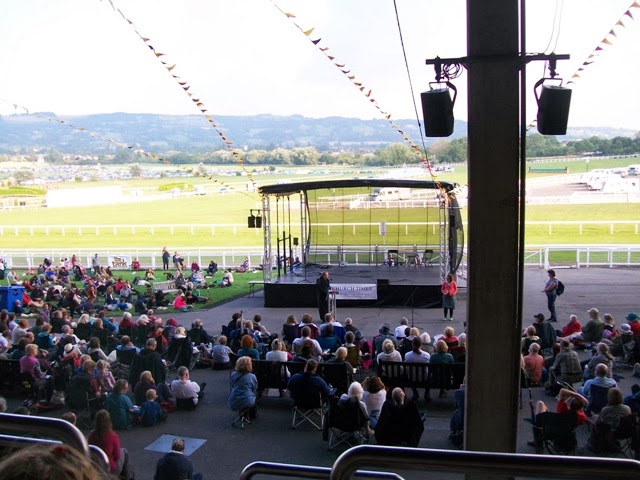
Last weekend, undeterred by the mud bath of the previous year we set off to Cheltenham for the Greenbelt Festival. I don't really know where the name came from or the thinking behind it, and maybe that doesn't really matter: because I think I know what it meant to me: the greenbelt: the place on the edge where life abounds.

It was a chance to catch up with lots of friends, to listen to inspiring speakers who refuse to be bowed by the ills of the world, to be surrounded by people who care, who are engaged, who want to make a difference, who believe that they can.

It was a chance to share stories and drama, poetry and music, laughter and tears, faith and frivolity.

It was a chance to sing "Hark the Herald" in a sweltering tent on an August afternoon.

It was a chance to hear the immortal line "In Switzerland, doing covers of Cliff Richard is cool."

I left Greenbelt feeling supported and loved, excited and energised, inspired and challenged. I left believing another way is possible and I can be part of it and make a difference. I am sure my local MP is delighted ...


Of course, I don't want to stay long-term in a make shift campsite on Cheltenham racecourse; but you know, I think I like the idea of staying in the Greenbelt: in the place on the edge, where life abounds.


Tuesday, 20 August 2013

In Light and Darkness


“In every human being there is an inner life, where light and shadows, joys and fear, trust and doubt mingle. Amazing breakthroughs can take place there” 

Brother Alois; Uncovering the Wellsprings of Trust in God; Taizé 2013.


A sun that rises
Through blossomed trees
The dappled light
That shines
Through shifting shadows

Where deepest doubts
And heart-felt trust
Criss-cross
As brightness
Through fading gloom

And fed by light
Life dares to creep
Over calloused bark
As joy that smiles
Through tight, gnarled fears

And beauty
Hesitates
But then
Takes flight
On fragile wings
Beneath
The canopy
Of
The tree of Life.

Tuesday, 13 August 2013

Where we might be, where we are

If all had gone according to plan, this would have been our final week in Corrymeela. As I write, the other one year volunteers, with whom we arrived full of anticipation on the North coast of Antrim almost a year ago, are now winding up their year and preparing to say goodbye to the place, and the people, who have been home for the last twelve months.

My thoughts are in Ballycastle this week, perhaps more so than at any point in the last few months. They are there with friends. Friends who are facing transition and change. Friends who are sharing memories and who are dreaming of new adventures. Friends who are about to step out into a future with excitement or with apprehension. Friends who are crying, probably, but hopefully friends who are laughing too. Oh, and friends who are drinking tea. I am sure there will be a lot of tea.


My thoughts are in Ballycastle this week. I however, am not there. I am in the city centre of Birmingham which is just a tiny, little bit different from the dramatic and beautiful coast of Northern Ireland. The fact that my thoughts have, for understandable reasons I think, drifted so often across the Irish Sea these last few days has left me reflecting once again on my experience of the past year.

Today, it is right that my thoughts are with those who shared the joys and challenges of my six and a half months in Corrymeela. But, today, it is also right that I am not in Ballycastle. Today, I am certain of this.

It is right that I am here. Here, with most of the boxes unpacked in a place which is beginning to feel like home. Here, looking back a little bit, but mostly looking forward. Here, excited about beginning a community life even if we have yet to find others to share it with. Here, reflecting on the vision and routines which might help make this new life a reality. Here, wondering if at some point someone might want to offer me a job. Here, with a million questions which don't yet have any answers.

It is right that I am here.

Friday, 9 August 2013

The Reality of Fiction

As anyone who has been reading this for any length of time has probably figured that out by now; I like words a lot. I like books too. I know this, because I have just moved house and carried what feels like half a library up two flights of stairs. I'm definitely with Roald Dahl when he writes:

"so please, oh please, we beg, we pray,
go throw your TV set away,
and in its place you can install,
a lovely bookcase on the wall."

Given a choice, the bookshelf wins hands down, every time... Actually, make that bookshelves: it's definitely plural!

Over the last few months I have had the luxury of being able to spend a fair amount of time curled up with a selection of good books. I have read some excellent, heartening, terrifying non-fiction. But mostly I have read stories. I have read stories set in the past and the present. I have read stories from close to home and far away.

I have taken great pleasure in reading lots of stories. Many of the best books I have read, I can't exactly describe as enjoyable. They are books that have made me smile, certainly, but also reduced me to tears. They are books where I have come to care deeply, passionately about individuals dreamt up in the imagination of another.

But maybe this is not pure escapism into an imaginary world of fairy dust. For me the great power wielded by these authors of fantastic fiction, is not that they can make me care about what does not exist; but that they are able to draw me more deeply into a world that does exist. While their characters, scenarios and events may be fictional creations, they are also able to speak of a deep reality. The reality of humanity, the reality of life.

Like many people, I am always a little suspicious of statistics, and not just because I prefer words to numbers. Despite our post-enlightenment obsession with facts, we are deeply suspicious of those same facts which we tirelessly seek. But we do want to know. Really know.

I wonder whether, in the same way that facts can be used to hide a deeper fiction; perhaps it is through fiction that we are able to discover deeper truth. Sometimes, perhaps, this uncomfortable fiction may be more real than we want to imagine. Sometimes perhaps, we leave our fiction uplifted by the very real enduring tenacity of the human spirit.

This is already long enough, but I feel I can't really end without at least a couple of recommendations, so go and get hold of a copy of Burnt Shadows by Kamila Shamsie and Mornings in Jenin by Susan Abalhawa, . Read them, smile at them, cry over them, care about them. Then remember to care about the real life characters too.

Monday, 5 August 2013

This is Freedom

We hear a lot about freedom. We hear of the 'freedom' of "anything goes" and of "each to their own." We hear of the 'freedom' of markets to drive up profits (and drive out prophets). We hear of the 'freedom' bought with guns and missiles and self-piloting drones. We could be tempted to get a little bit cynical about this "gift of freedom" we have been given: it doesn't always look like a particularly attractive present.

But there is another freedom. And it was this other freedom which kept cropping up during the bible introduction of our first week in Taize this year. It is this other freedom which is the inspiration for this poem.

A saying no
Allows
The yes of
A whole life
A choice to close
The door
To other possibilities
By saying yes
To fullness of life
Where freedom flies

A life lived
At the edge
Of what we know
As others call
Us out
Beyond ourselves
And in their love
We touch
The fullness of life
Where freedom flies

In the daring trust
Of a human heart
Where a spark
Of the infinite
Touches
The mortality
Of the everyday
This is the place
Of fullness of life
Where freedom flies

Friday, 26 July 2013

Cantate Domino!

Next (short) installment from my Taize poetry book:

While melodies sing
Unknown sounds dance
From twisted tongues
As words which mean
So little
Say so much
To our silence

And laughter sings
In souls that dance
To a beat of joy
A harmony of hearts
Finds voice
To the tune
Of shared silence

Together with useless fact of the day: in the Taize songbook (at least this year's addition, I can't vouch for any others) there are four songs, in four different languages, which contain the words "Sing to God" (Cantate Domino, Spiewaj Panu, Cantarei ao Senhor, Singt dem Herrn). And during the time I was there we sang all of them.

Monday, 22 July 2013

A simple place of meeting


After three weeks in my favourite place on earth, we are back in the UK and back on the internet! Those of you who know me well will know I could talk (or write) at length about why I love Taize so much ... but breathe a sigh of relief because I intend to resist the temptation to do so here. Instead, over the next couple of weeks, I am going to post the poems I wrote while we were away which may or may not capture something of what Taize means to me.

This simple place
Of meeting with the other
To find I also meet
The myself I thought I knew
To know who you are
Is to discover who I am
As both offering and open
We meet here
Face to face

Where language sometimes falters
But simple words speak trust
And found in broken English
Is the wholeness of a soul
From which is born
The fragile friendship
Of our shared humanity

And so I leave
This simple place of meeting
The same, but changed
More fully
Me